Marking the course: Realising the ambitions of the post-16 white paper

On the publication of the government’s post-16 white paper, Debbie McVitty and Mark Leach respond to the challenges it poses both to universities & colleges as well as policymakers, if the ambitions are going to to translate in to real and lasting reform

Date:
27 October 2025
Authors:
Dr Debbie McVitty, Mark Leach MBE
Image: Ikon

Our reforms will bring stability to the sector through a commitment to sustainable funding. And in return we ask universities to focus on their strengths, to specialise and collaborate, and align what they do closely with the needs of the country.

– Bridget Phillipson, Pat McFadden & Liz Kendall. Ministerial foreword to the post-16 education and skills white paper

01

Introduction

Labour came into power with an offer to business, industry, and civil society: work with us to turn the challenging conditions we have inherited into a future we have reason to feel optimistic about. The Labour government’s plan for post-16 education and skills draws on two of the party’s fundamental purposes in government: growth and opportunity.

These are not merely abstract terms; they are about people, and the degree of confidence they can have that if they put their mind to it, they can achieve a bright future for themselves and their families. Inclusive economic growth raises living standards, it increases the amount of secure and fulfilling work available, and it extends people’s opportunities to be part of the new ideas, creativity and innovation that are making exciting things happen around the country.

The Prime Minister’s eye-catching pledge to work towards two-thirds of young people under 25 participating in some form of higher level learning is emblematic of the government’s efforts to work towards a wider distribution of education opportunity across social classes and the country as a whole.

These are values and goals that are (in a non-partisan way) shared with much of the post-18 sector, grounded, in many cases, in direct and deep experience of serving educationally disadvantaged groups.

On a very practical level, leveraging the transformative power of education equates to individuals developing the relevant knowledge and skills to secure good work and careers. But it also means building personal confidence, new social ties and capability to shape the world around them – preparing them to solve problems, and create novel ideas of their own. These aspects of higher education transformation are not in opposition to each other; in the best kinds of education settings they are mutually reinforcing.

As we explored in Tooling Up, long term policy incoherence across FE and HE over the years, combined with policy efforts over the last two decades to drive greater competition in the higher education market, leaves the government with two critical problems: a fragmented post-18 sector with low trust in government and its regulator, and a lack of positive incentives it can offer, beyond further regulation, to unite the sector around its agenda, thanks to the economic conditions it has inherited.

Conscious, perhaps, of the weak hand the government has to play, from the outset Labour ministers have been by turns emollient and combative with the HE sector: sympathetic to the financial pressures facing institutions, supportive of the goals and aspirations of higher education, while being clear that the government expects the sector to fall in with its plans for a tertiary post-16 skills-led system – with a deeply unpopular planned levy on international fees thrown in for good measure.

Even so, as Post-18 Project fellow Debbie McVitty has argued, the sector should be seeing the Prime Minister’s two-thirds participation target as a win – not only because the government has made its aims explicit and trusted higher education institutions to find ways to fall in behind, but also because the priorities the government has chosen are areas in which many heads of institution feel they have much to offer.

The government’s skills agenda is ambitious: a coherent post-16 skills system, spanning everything from young people whose prior educational experience have already left them at high risk of NEET status, to aspiring postgraduates and PhDs, that delivers on national industrial priorities, and makes the UK as a whole more secure, but is rooted in the specific needs and challenges of places and coordinated through strategic (mayoral) authorities.

This new system involves several critical changes in how post-18 education is currently configured:

  1. Collaboration between institutions whether “vertical” FE-HE collaborations or “horizontal” collaborations among post-18 institutions (some of which are, of course, FE colleges) are to be considered desirable where there are opportunities to capture efficiencies, enhance the offer to the region, or realise economies of scale.
  2. Greater specialisation combined with active coordination within regions around defined skills gaps and future skills needs, supported with data and insight from Skills England, and grounded in the presumption that it will in most cases be clear which institution(s) are best placed to meet those needs.
  3. A gradual pivot towards a “building block” approach to education and training, with short courses, skills bootcamps and standalone modules, and defined degree “exit” points at levels four and five, as well as “apprenticeship units,” primarily funded through the Lifelong Learning Entitlement and Growth and Skills Levy offering greater notional flexibility to students and employers on accessing post-18 education opportunity and acquiring skills.

Colleges and universities via the Association of Colleges and Universities UK have signalled to government that they are open to this shift from a competitive framework to a more coordinated one, showcasing in advance of the publication of the white paper various existing FE-HE collaborations and analysing the barriers to building these kinds of collaborative partnerships across the whole system. But an institutional openness to working with government to enact this shift can only ever be the first step – both government and institutions need a detailed understanding and grasp of the material and practical implications of this shift and how that change can be supported.

The post-16 white paper should, then, be the government’s roadmap for the sector, outlining the steps it will take to incentivise or otherwise enable higher education institutions to support and deliver the government’s agenda. As it stands, though, it’s not clear that the government has fully got to grips with the scale of realignment that this might involve, or how this realignment might be incentivised.

Much activity will arise from the measures outlined in the white paper – taskforces, consultations, and even (“when parliamentary time allows”) legislation. Many of these initiatives are undoubtedly desirable in the abstract, such as a taskforce on tackling HE cold spots, the creation of a postgraduate access resource hub, or work to improve the quality of public information for prospective students. But without a systematic route towards systemic change, many of these activities will remain sector busywork, unlikely to deliver material impact – and some of the measures discussed are equally likely to serve to distract from the government’s core agenda.

The policy critique is one thing; but there is arguably a larger issue with the white paper’s technocratic approach in that while it bristles with statistics and evidence, it does not read as being meaningfully grounded in the real concerns of students, communities, or employers as these manifest in lived experience, or introduce significant measures to explore how those concerns might inform the development of post-16 provision on an ongoing basis, for example, through strengthening learner and student voice, community engagement in institutional governance, or incentivising further employer investment in training.

This matters because in difficult economic times, especially for a sector treated, in the words of Secretary of State Bridget Phillipson, as a “political football” by the last government, and now bruised by the international levy proposals, as wrangling commences over the policy detail of the government’s proposals government and sector will need to return to a common sense of the most critical problems holding back individuals, communities, and businesses, and agree a shared mission to tackle these.

Our analysis of the white paper focuses on the most significant policy challenges, requiring the deepest thinking and toughest conversations in the coming months. These are the areas we’ll be focusing on as part of The Post-18 Project in our mission to introduce new thinking, ideas and policy solutions to the post-18 education policy debate.

02

Collaborating, coordinating and specialising

“The government’s vision is that providers will be able to leverage their individual comparative advantage whilst working more closely together to create a compelling regional offer that supports students and drives growth, building on existing good practice across the sector. This could be as simple as providers that are based in the same city sharing back-office functions and estates. More importantly, it could also extend to allowing groupings to emerge which will support more structured regional offers across research, skills, teaching, and research and development.”

The white paper makes no distinction between collaboration and coordination, though both are absolutely material to the delivery of the government’s objectives in different ways.

The choice to collaborate, to coordinate and/or to “specialise” is ultimately, as the white paper observes, a strategic choice on the part of individual institutions guided primarily by a combination of mission and market analysis.

It is not, as the white paper points out, for government to direct the actions of autonomous institutions – though many would argue the government or a designated actor on behalf of government needs to play a much more explicit role in brokering outcomes if an autonomous institution becomes insolvent, thus placing public money and public assets at risk as well as leaving students without recourse. But even outside these extreme cases, there is still more the government could do, or cause to be done, to drive forward these agendas.

For our purposes, we take “collaboration” to specifically mean two or more institutions working together to create a jointly owned resource, service, or product, or a new corporate entity. The drivers for collaboration are typically efficiency but the conversations currently live in the sector are also focused on the opportunities for realising value from collaboration. This policy agenda is making progress under the auspices of the transformation and efficiency taskforce which is well-positioned to delineate the limits of what can be achieved within the current landscape and the conditions under which this agenda could move further and faster, though the government may wish to consider how the scale of collaborative activity could be monitored to determine whether it is actually happening and if not, why not.

Coordinating is a potentially different case, and could be defined as two or more institutions making decisions about their market offer – specifically what is offered or how it is positioned – in light of what the others around them are doing. This could happen to some extent without active inter-institutional communication, with, for example, an internal portfolio review taking a decision to withdraw from offering certain subjects on the grounds that these are not competitive in the current market.

It could also happen in ways that are not obviously anti-competitive, for example, in efforts to create regional curriculum mapping demonstrating pathways from one institution to another to build pathways of opportunity in particular subject areas – though purists might view some activity of this nature as market collusion or restrictions to student choice.

In the Labour imaginary, however, there seems to be an expectation for institutions to go even further to, under the auspices of their strategic authority and Local Skills Improvement Plans, broker collective approaches to tackling skills gaps and addressing future skills needs. We’d argue that activity of this nature is absolutely necessary where the market has failed to deliver the necessary provision or there is insufficient student demand to support multiple providers to offer provision in specific areas, but that there will need to be much more clarity from government and regulators about the contexts in which active market coordination of this nature is permitted and deeper thinking about how it can be incentivised.

Institutions cannot realistically be expected to act against their own interests – and yet it is the institutional pursuit of market share that to some extent has created the instability we currently see in the sector. The government has a role, therefore, not only in removing barriers to collaboration, or coordination, where they are shown to exist – the white paper pledges, for example, to seek clarification from the Competition and Markets Authority on what lawful collaboration means in the post-16 context – but to consider where there are prospective policy interventions to support innovative collaborative efforts to grow the market – particularly in areas of defined skills need. There is also a corollary need for monitoring of provision across regions and the equality impact assessment – while the notion of specialisation may create space for diverse institutions and diverse educational offers to flourish, not every institution is ready to accept every student. There are already subjects that are very hard to study outside the research-intensive part of the sector, and there is always a risk that even with multiple institutions involved none is prepared to add difficult, expensive, or hard to recruit to subjects in their portfolio. It is very hard to see how to sustain a broad portfolio across a group of institutions without some degree of coordination or planning.

Beyond the core question of lawfulness, there are questions of whose interests are served in regional coordination, and what expertise and knowledge is available to inform strategic decision-making. The FE case is instructive here: FE colleges have a duty to have due regard to local skills improvement plans in making decisions about the provision they will offer. But in practice, if a college does not see how it can sustain demand for provision from students it is not in a position to offer it. Knowing there is a skills gap based on labour market intelligence is not necessarily sufficient to cause a response. Providers working together may be able to find ways to share costs, risk, teaching staff or even students through a joint offer. That coordination work will be strengthened still further by involving relevant industry and employer representatives in the oversight of these joint arrangements.

The principle extends to general governance: institutional boards of governors, as the white paper argues, need to be able to have the strategic capability to secure institutional financial sustainability, which may include collaborative ventures and/or coordination with other providers. For individual institutional boards of governors to have due regard for regional needs they arguably need direct engagement and representation from regional stakeholders who are empowered to advocate for the strategic execution of the institutions’ regional development mission, as well as a reasonably well developed knowledge of how regional economic development works in order to understand the material and non-material risks and potential rewards attached to innovation.

“Specialising” appears in the white paper as a corollary to the potential for collaboration and coordination – the assumption being that regional and national needs are better served by diverse institutions doing fewer things to a high standard. The white paper signals that government intends to exercise its prerogative to allocate public funding in line with a revised definition of excellence (in the case of research funding) and strategic imperative (in the case of the Strategic Priorities Grant) that is likely to have material impacts on the sustainability of some research or education provision in particular institutions, which leaders will have to take into consideration in their financial planning.

However, beyond this ominous prospect, this notion of “specialisation” is offered only at the conceptual and speculative level, with some text wondering whether some institutions may “specialise” in a specific type of research, in particular subject areas, or in teaching, while still protecting “important links between research and teaching.” Seen from one perspective these proposals simply describe the system we have already – different kinds of institutions managing a diverse portfolio of research and teaching with, undoubtedly, some provision subsiding other parts. It is also worth noting that institutions that are specialist can face distinctive challenges especially if the costs of delivery exceed the unit of resource – cross subsidy can in some cases make it possible for broad-based institutions to sustain high-quality specialist provision.

If, however, the white paper is pointing towards a more radical reframing of the post-18 ecosystem then there needs to be reckoning with the incentives in which HE providers operate – particularly the dominance of league tables as perceived indicators of institutional prestige and quality and the role of research outputs and reputation in driving the league table positions on which institutions depend to support their recruitment of international students. Government has no direct control over league tables, but if it wants to move towards a more distinctively mixed economy in institutional mission and offer then it will need to offer alternative incentives to balance their powerful draw.

A further undercooked element of this notion of specialisation is the relative homogeneity of the academic contract, specifically in universities, and – as the white paper lightly acknowledges – the narrowness of recognition and reward frameworks for academic performance, which can prioritise research publications at the expense of wider, albeit less easily measurable, impacts. This is a long standing challenge, and is not one that institutions can tackle individually – it requires some level of collective assessment of the changing conditions of academic work, and collective action on future workforce planning to effect systemic change.

Finally, the market effects of private sector provision need to be more fully understood – there is undoubtedly much good quality private provision, including highly specialist and innovative provision, but there is also the observable phenomenon of private providers offering the kind of generic provision on which they can realise significant margins for shareholders, without having to contend with the broader mission-led costs that face providers in the public sector, such as civic engagement. Plans in the white paper are restricted to tackling low quality (in whatever part of the sector that it manifests) through applying restrictions to growth and fee uplifts, and requiring providers of franchised higher education to register with the regulator, but these measures do not really address the ways that the private sector can substantially invest in capturing particular parts of the HE market while not sharing the costs of delivering an HE system that is attuned to public policy objectives.

03

Stackability and portability

“We will expect providers to offer more flexible, modular provision and strengthen progression routes from further education into higher education, supported by transferable credits. We will consult on making student support for level 6 degrees conditional on the inclusion of break points in degree programmes. This marks a significant shift towards a more inclusive and adaptable model of learning, empowering individuals to tailor their educational journey.”

This, it hardly needs pointing out, is not the first time a government has confidently set the ball rolling on credit portability, only to watch that ball swiftly disappear down a rabbit hole of principle-based and practical issues. The Higher Education and Research Act 2017 tasks OfS with a duty to monitor and report on provision for student transfers and the extent to which this provision is used. Additionally, OfS “may” facilitate, encourage, or promote awareness of provisions to enable student transfers. While OfS’ annual reporting has accordingly included available data on the numbers of students who transfer to another provider within a year of starting their course – 1.7 per cent on the last annual count – OfS has not made facilitation of transfer a priority since its inception.

What is now the Lifelong Learning Entitlement provision for flexible student finance was originally proposed in the Augar review of post-18 education and funding – which also recommended the automatic award of level 4 and 5 qualifications for those pursuing a full level 6 degree, noting that this would support credit transfer. The 2021 Skills for Jobs white paper which sought to implement the planned student finance reform included an announcement that the government would “determine how we can best stimulate credit transfer between institutions and courses” – without, ultimately, delivering on that intention, possibly because the operational arrangements for delivering a student finance system organised around credit rather than elapsed time has been the main area of focus ever since.

In that time, however, the financial situation of higher education providers has materially worsened, meaning that the appetite to take a gamble on offering courses in a chunked-up form for lower guaranteed income is likely to be low, especially as early signals suggest the student demand for this kind of modular provision may not be especially high, increasing the risks to institutions. It is wise, therefore, to roll out the LLE over a number of years, focusing on priority areas where there is an appetite to innovate on a smaller scale.

The saga of policy efforts to facilitate “credit transfer” fail, in our view, because “credit” functions admirably to validate the comparability of awards at different levels, but has almost no value as educational currency in the UK system when it comes to determining whether a student has the prior educational attainment that would prepare them to take up a course of study at the next level.

Simultaneously, the notion of breaking higher education programmes into discrete “chunks” of value goes against the pedagogic grain to some extent. Current thinking on best practice in learning design tends towards taking a programme-based approach – this allows for a reduction in the overall volume of assessment, the distribution of critical skills development provision across programmes (rather than trying to cram a wider range of skills into every single module) and the use of synoptic assessments that can allow students to demonstrate accumulated learning across different programme elements.

Increasingly, education leaders tell us, their thinking is that offering a plethora of module choices can create a fragmented experience, increasing the likelihood that students struggle to form connections, both with each other, and between their various learning opportunities. Streamlining the programme – perhaps in tandem with offering greater opportunity for exercising of choices and pursuing interests within particular programme elements – increases the experience of studying as a cohort, ensures students have a more consistent experience, and gives programme leaders a much greater degree of confidence that students are developing the skills and knowledge they were promised.

None of this is a reason to abandon the notion of building a flexible lifelong offer based on discrete but stackable elements across the whole of level 4 and above provision, but it requires much more than simply building the funding infrastructure, complex though that is, and assuming that institutions and students will rally round. To move such provision from the margin to the centre of provision across level 4 and above requires creative thinking about programme design, curriculum, and assessment, as well as integrating flexible modular provision fairly and robustly into arrangements for assessing quality and standards – not to mention tackling the various complexities involved in student data collection and reporting, managing admissions, and logging of awards.

Additionally, as Jim Dickinson has argued in Doing better, getting better a mass higher education system has to be prepared to accommodate the lived realities of diverse students’ learning experience. This principle appears throughout the white paper in discussions on access, inclusion, and general opportunity, but it does not show up in any meaningful sense in a coherent policy agenda to reimagine the full-time student experience to align with the kind of higher education ecosystem the white paper envisages. Paid work, health (not only mental health), academic support for navigating education choices, and designing meaningful learning communities in which students can develop critical self-efficacy, agency, and interpersonal and intercultural skills are all part of a high-quality system, and need to be collectively taken on as an accountability to the nation’s young people.

Whether there needs to be an independent review of higher education, or post-16 education, is now a moot point, but there would be a strong case for convening an independent expert panel on curriculum, assessment, quality, and student experience in a “stackable” post-18 system, not only to work through some of the knottier issues but to cause the kind of productive, creative conversation across the FE and HE sectors that can build real support for executing the shift.

04

Regulation

“The Office for Students will act as a primary regulator for all higher education providers, including Further Education Colleges delivering higher education…We will support the Office for Students in developing a reformed regulatory framework that focuses on driving out pockets of poor performance, strives to continue to improve quality and safeguards the financial health of the system in a balanced and proportionate way…We will empower the Office for Students and UK Research and Innovation to work together to develop a risk-based, coherent approach between the Office for Students’ regulatory and UK Research Innovation’s research responsibilities that delivers the strategic aims and ambitions set out in this paper.”

When it comes to executing the provisions of the white paper for higher education provision all roads lead to OfS. Actions the regulator will need to take as a result of the white paper include:

  • Reviewing degree awarding powers, including developing new higher technical qualification awarding powers
  • Consulting on a new framework for registration incorporating FE colleges offering provision at level 4 and above
  • Implementing new high-level regulatory objectives around supporting beneficial collaboration
  • Creating a more robust process for market entry
  • Strengthening management and governance conditions of registration
  • Strengthening financial monitoring and data collection processes
  • Joining the task and finish group to tackle HE cold spots
  • Reforming regulation of equality of opportunity, including extending access work to postgraduate taught and research provision and otherwise becoming more risk-based
  • Exercising new powers to conduct quality investigations and intervene in cases of low quality
  • Implement tougher standards for franchised provision
  • Work with UCAS and the sector to improve the quality of information available to students
  • Working with government to develop measures of progress in higher education (ie education gain)
  • Assessing the impact of generative artificial intelligence on maintenance of degree standards

Additionally, the OfS quality regime will become toothier, with material impacts on provider finances in the form of recruitment limits and restrictions to inflationary fee uplifts.

This shopping list of regulatory actions is unlikely to raise the spirits of the HE sector, which generally has low trust in the regulator and is deeply sceptical in particular of the legitimacy of using the proposed new integrated quality regime as a basis for determining fee levels.

OfS is clearly on a journey in its efforts to demonstrate regulation that is reasonable, transparent, fair, and proportionate. It is not, in the final analysis, obliged to take the regulatory approach that the sector might prefer, though there is a strong practical case for introducing a greater degree of formal co-regulation in areas where OfS is likely to struggle to sustain the capacity to act at the pace and scale required, or produce regulatory guidance at the level of sophistication that the sector would find valuable.

However, the wider risk for government is arguably less from sector cavilling at aspects of the regulatory regime, than that OfS in focusing on developing and strengthening direct regulation, fails to support the wider sector change and transformation the white paper has set out.

To achieve some of the core objectives of the white paper requires a body that can convene development activity around collaboration and innovative provision, as well as define and enforce regulatory expectations. Much of OfS’ current output actually already exists in the broad “development” space, offering insight and guidance to inform the sector in developing good practice, though it may not be having the impact it could have if OfS had a better relationship with the sector in general.

The white paper seems to indicate that if the only body available to do that developmental work is a regulator then it should be the regulator’s objective to do that work, and proposes to reframe the general objectives of the regulator to accommodate that approach. If that is the case, then government and OfS should jointly consider how OfS can more actively and visibly differentiate between its oversight and accountability functions, and its development and insight functions. This could potentially create space for the sector to engage in shaping the latter, put forward ideas, and frame significant developmental structural challenges without fear of triggering unwarranted regulatory attention or coming up against existing regulatory shibboleths.

05

Conclusion

The Labour government is facing significant political and economic headwinds and any optimism that a return to a technocratic approach to policymaking will reassure the public has long since dissipated.

If Labour is looking for a compelling story to tell it could do worse than embracing the potential of its post-16 sector to make a real difference in the lives of individuals, communities and regions.

The government has offered an ambitious agenda in the post-16 white paper. But for those changes to manifest in people’s lives it will need to enlist the support of the sector to tackle the longstanding and deep challenges that have stymied policymakers with similar ambitions in the past.

References

Department for Education (2025) Post-16 Education and Skills. CP 1412. London: Crown copyright.
UK Parliament (2017) Higher Education and Research Act 2017. London: The Stationery Office.
Office for Students (n.d.) Evaluation of the higher education short course trial. Available at: https://www.officeforstudents.org.uk/publications/evaluation-of-the-higher-education-short-course-trial/

Augar, P. (Chair) (2019) Independent panel report to the Review of Post-18 Education and Funding. CP 117. London: Department for Education.

Office for Students (2025) Annual report and accounts 2024-25. London: Office for Students.
Department for Education (2021) Skills for jobs: lifelong learning for opportunity and growth. CP 380. London: Crown copyright.

The Post-18 Project (n.d.) Tooling up. Available at: https://post18.co.uk/tooling-up/

Association of Colleges and Universities UK (n.d.) Universities and colleges unite to call for overhaul of post-16 education system. Available at: https://www.aoc.co.uk/news-campaigns-parliament/aoc-newsroom/universities-and-colleges-unite-to-call-for-overhaul-of-post-16-education-system

The Post-18 Project (n.d.) Doing better, getting better. Available at: https://post18.co.uk/doing-better-getting-better/
Share the article:

Marking the course

Dr Debbie McVitty
Fellow
Debbie McVitty is Editor of Wonkhe and an honorary fellow of the School of Education at the University of Birmingham. Debbie is a former chief of staff at Universities UK, director of policy at the University of Bedfordshire, and head of policy at the National Union of Students.
Mark Leach MBE
Founder & Chair
Mark Leach is the founder and Chair of The Post-18 Project. Mark is also Editor in Chief of Wonkhe – home of the higher education debate – a platform he founded in 2014 after the first part of his career in higher education policy and as a Labour adviser. Mark was appointed MBE for services to higher education in the King’s Birthday Honours in 2023.

The cashpoint campus comeback franchising, fraud, and the failure to learn from the FE experience

A policy paper on the chronic lack of institutional memory from regulators and government and the urgent need for cross-sector learning

Date:
26 June 2025
Authors:
Mark Leach MBE
Image: Ikon
01

Executive summary

The higher education sector is mired in a franchising crisis that mirrors – almost precisely – scandals that rocked further education a decade ago. Over £1 billion in tuition fee loans has flowed to unregistered providers over the past three years, while fraudulent activity, exploitative recruitment practices, and catastrophic student outcomes proliferate. The National Audit Office has uncovered organised crime, ghost students, and continuation rates as low as 66 per cent at some franchised providers.

This paper argues that the government’s response represents a troubling case of institutional amnesia. In 2020, the Education and Skills Funding Agency (ESFA) implemented comprehensive reforms to FE subcontracting that addressed identical issues – geographical distance, volume controls, whole programme restrictions, and enhanced oversight. These reforms worked. Yet, the Department for Education (DfE) is now proposing to reinvent the wheel for higher education, with implementation not set to begin until 2026 and full effect not until 2028. This is even harder to understand when you consider that ESFA was recently absorbed back in to DfE – it appears that all learning has been lost in the process.

The central challenge is not whether reform is needed – it manifestly is – but why proven solutions from one part of the tertiary sector cannot be immediately adapted for another. This paper demonstrates how reforms made in FE could be translated to HE within months, not years, potentially saving hundreds of millions in misallocated public funds and protecting tens of thousands of vulnerable students from educational malpractice.

02

The franchise explosion: Déjà vu all over again

When, earlier in 2025, Education Secretary Bridget Phillipson declared the current situation “one of the biggest financial scandals in the history of our universities sector,” she was both right and wrong. Right about the scale – wrong about the novelty.

As early as 2014, investigations uncovered Romanian builders trafficking people to the UK to fraudulently claim student loans, and colleges dubbed “the ATM” where students collected their £11,000 and vanished.

The numbers tell the story. Student enrolments at franchised providers more than doubled from 50,440 in 2018–19 to 108,600 in 2021–22, reaching over 138,000 by 2022–23. In 2023–24 alone, nearly £450 million in tuition fee loans went to students at providers not registered with the Office for Students (OfS). Private providers report profit margins exceeding 50 per cent – companies house records show that one turned over £73 million with education costs of just £17 million, pocketing a 53 per cent pre-tax profit.

These are not the specialist providers or innovative upstarts that former universities minister Jo Johnson envisioned when comparing validation requirements to “Byron Burger having to ask permission of McDonald’s to open up a new restaurant.” Instead, we see cookie-cutter business degrees delivered from converted office blocks, sold door-to-door with promises of “£15,000 funding today” and attendance requirements of “just two days a week.”

@eduexukReady to Study in the UK and Get Financial Support If you have UK/EU citizenship or Pre-Settlement/Settlement/Refugee status, you can access government-funded courses with up to £15,000 in maintenance funds The best part: ✅ Study only 2 days a week ✅ Apply with/without qualification ✅ No age limits—everyone is encouraged to apply! ✅ FREE expert guidance for your applications and funding! Contact us to begin! 𝐄𝐃UEX………………. 07777 719 330 contact@eduex.co.uk www.eduex.co.uk 117 Whitechapel Road, 2nd Floor London, E1 1DT #uk #ukeducation #founding #undergradute #study #studyinuk #bussinessmanagement #healthsocialcare #law #accounting #accountingfinance #project #projectmanagement #govt♬ original sound – EduEx

The targeting is cynical and precise. In 2022–23 and 2023–24, over 65 per cent of students eligible for student finance on subcontracted courses were from nationalities where English is not the first language – particularly Romanian nationals and those with pre-settled status. The Student Loans Company reports thousands of students who receive maintenance loans but never draw down fee loans – a clear indicator of enrollment purely for cash access. In 2023–24 alone, a Freedom of Information request to the Student Loans Company revealed that 10,582 students in England received first instalments of maintenance loans without any tuition fees being paid.

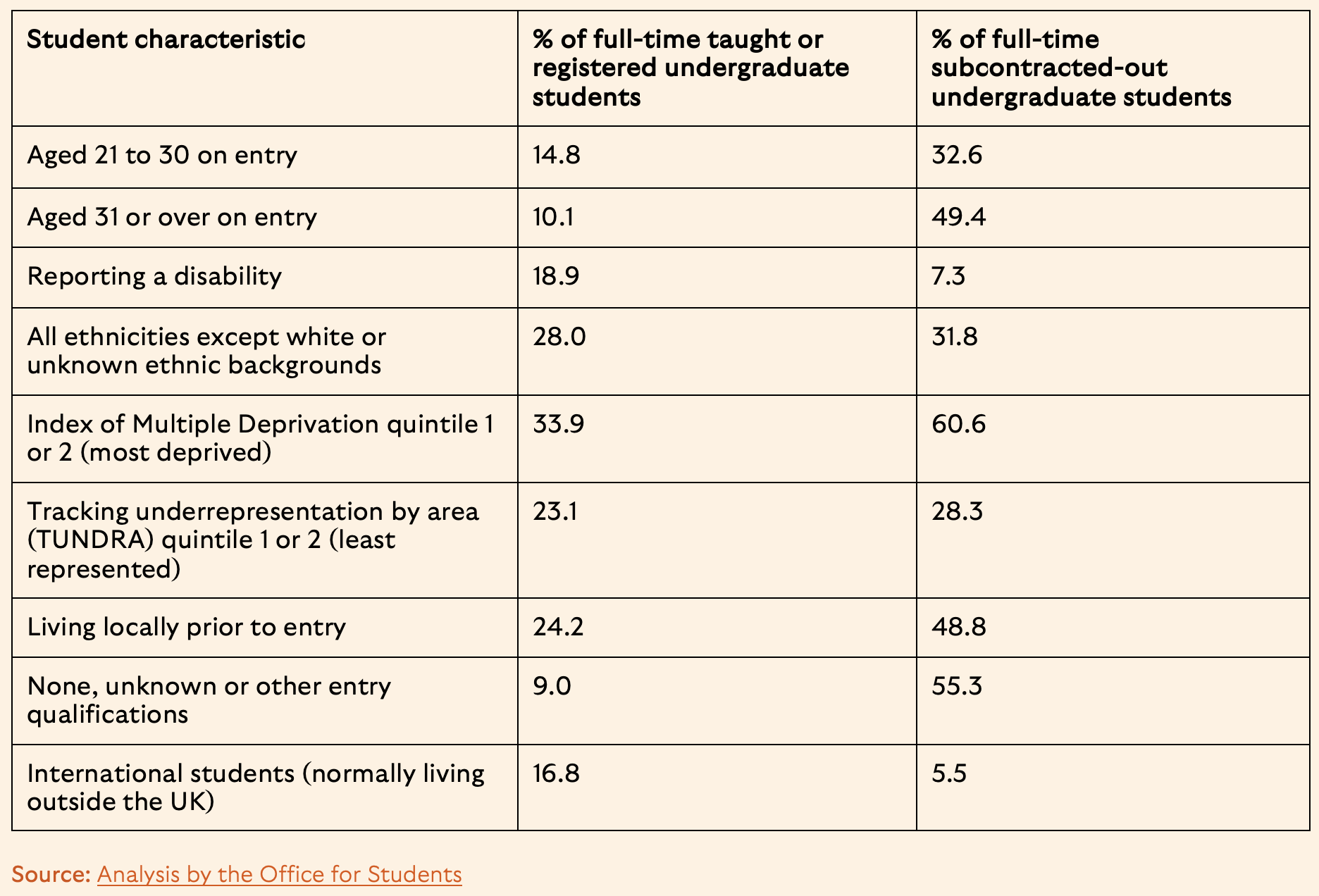
The human cost is significant. Of nineteen franchise partnerships examined by OfS, only two met the minimum 80 per cent continuation threshold. At one large partnership, just 66.7 per cent of students continued to their second year. These are predominantly students from disadvantaged backgrounds – 62 per cent from high deprivation neighbourhoods, compared with 40 per cent across all providers. Nevertheless, while franchise provision shows high rates of economic disadvantage, the proportion reporting disabilities is suspiciously low – suggesting either poor support or active discrimination in recruitment.

03

The anatomy of exploitation

Understanding how this crisis developed requires examining the ecosystem that enables it. At every level, perverse incentives align to exploit students whilst extracting maximum profit from public funds.

The ghost student phenomenon: NAO investigations revealed students who exist only on paper – enrolled to trigger loan payments but never attending classes. In one case, a university discovered the “majority” of students at a franchise partner weren’t producing their own assignments. When challenged, just six per cent responded, with evidence suggesting even these were coached. The Student Loans Company identified 3,563 suspicious applications worth £59.8 million linked to organised crime. These aren’t isolated incidents but systematic fraud.

The profit pipeline: The financial flows reveal the scandal’s architecture. Universities receive 12.5 to 30 per cent in franchise fees. Private providers then extract profits of 30 to 53 per cent. Domestic agents – a largely invisible industry until recently – take commissions for each student recruited. By the time money reaches actual education, perhaps 30 pence of each pound remains. One provider showed a £73 million turnover with just £17 million spent on education – the rest vanishing into administration and profits.

The absence of student voice: Also telling is the absence of independent student representation at franchise providers. There are rarely students’ unions, few course representatives with real power, and little independent advocacy. When students at one college investigated by OfS raised concerns in meetings, inspectors appeared to tick the “student engagement” box based on process not outcomes. Students don’t know their rights, can’t access support, and have no collective voice. This isn’t accidental – it’s designed to prevent challenge to the business model.

The lag that enables: Perhaps most pernicious is how outcomes-based regulation fails when growth is exponential. Continuation rates are measured over years – providers can recruit thousands before poor outcomes become visible. By then, owners have extracted millions, students have accumulated debt, and new providers have emerged to repeat the cycle. The system’s rear-view mirror approach enables exploitation by design.

04

Why memory matters: The FE precedent

What makes this crisis particularly galling is that further education faced – and largely solved – identical problems. Between 2014 and 2020, the ESFA witnessed widespread abuse of subcontracting arrangements – provision delivered hundreds of miles from lead providers, excessive management fees, students enrolled solely to access funding, and quality disasters hidden behind commercial confidentiality.

The parallels are uncanny. Where universities retain 12.5 to 30 per cent of fees, FE providers were skimming similar percentages. Where London-based companies now recruit students with pre-settled status for business degrees, FE saw similar targeting of vulnerable communities for basic skills provision. Even the ghost student phenomenon – learners who existed only to trigger funding – plagued both sectors.

The ESFA’s response was comprehensive and effective. In 2020, following CEO Eileen Milner’s stark warning in 2019 that “abuse of subcontracting will only ultimately serve to limit access for learners,” the agency launched a consultation that resulted in sweeping reforms.

These included:

  • A requirement for governing bodies to approve and publish a clear educational rationale for any subcontracting
  • Prior approval for geographically distant provision
  • Volume controls limiting subcontracting to 25 per cent of income
  • Restrictions on whole programme subcontracting
  • Direct contractual relationships with third parties
  • A single set of funding rules across all provision
  • Development of an externally assessed management standard

Crucially, these reforms were implemented within eighteen months, with most taking effect from the 2020–21 academic year. They worked. Subcontracting volumes fell, quality improved, and the most egregious providers exited the market. The Association of Colleges now reports that where subcontracting remains, “models are generally strong and reflective of local demand.”

05

Learning from FE’s experience: strengths and gaps

Four years after implementation, FE’s reforms show both successes and shortcomings that HE must learn from.

What worked well

Board-level accountability transformed franchising from a finance office decision to a governance priority. As college board minutes now demonstrate, subcontracting is a standing compliance item requiring active oversight. The requirement for published rationales forced transparency – no longer could providers hide dubious arrangements behind commercial confidentiality.

The prospect of a direct Ofsted inspection for large subcontractors changed behaviour. AELP’s Simon Ashworth notes that clearer lines of responsibility improved both quality and financial flows. The 20 per cent fee retention expectation, while not statutory, created a benchmark that shifted sector norms.

Where gaps remain

Nevertheless, implementation revealed weaknesses HE must address. The DfE customer forum shows ongoing confusion about audit requirements – practitioners report 12-week ESFA response times and ambiguity about filing requirements. And ESFA’s own 2023–24 assurance guide reveals that routine audits check funding-rule compliance but “do not check for compliance with the subcontracting standard” – the headline reform sits outside regular oversight.

Administrative burden fell heavily on small specialists. FE Week’s warnings about distance caps putting rural and SEND providers “out of business” proved prescient. The lack of a statutory fee cap means some providers still retain excessive percentages if they can “evidence value.” Regional variation adds complexity – devolved authorities interpret standards differently, creating what one multi-campus principal called “a compliance postcode lottery.”

06

Why DfE’s current proposals fall short

The Department for Education’s consultation proposals, while acknowledging the crisis, represent a fundamentally flawed approach that misunderstands both the scale and nature of the problem.

The centrepiece – requiring providers with over 300 students to register with OfS by 2028 – fails on multiple grounds.

The timeline is inexcusable: Waiting until 2028 for full implementation borders on regulatory negligence. The current growth trajectory suggests over 200,000 students will pass through franchised provision before controls take effect. At current dropout rates, that represents 60,000 students failing to continue – each saddled with thousands in debt. The NAO has already identified organised crime in the sector – waiting four more years while criminal enterprises operate with impunity defies comprehension.

This timeline also contradicts the government’s own rhetoric about urgency. As Phillipson herself noted: “This problem has been growing and has been highly concentrated in a small number of providers in the sector.” If the problem is both growing and concentrated, delay makes no operational sense.

The threshold is too high: Setting the bar at 300 students ignores how damage accumulates. A provider teaching 250 students at a 66 per cent continuation rate still represents 85 failed students annually. Across multiple such providers, the aggregate harm is substantial. FE learned this lesson – even smaller providers can cause significant damage when operating at scale across multiple partnerships.

Registration alone won’t solve systemic or incentives issues: OfS registration is necessary but insufficient. As cases have demonstrated, registered providers can still engage in academic fraud, aggressive recruitment, and poor practice. The register was never designed to handle profit-driven providers operating at the margins. Without addressing the fundamental incentives – the extraordinary profits available from minimal delivery – registration merely legitimises current practice.

OfS itself has acknowledged capacity constraints, temporarily closing new registrations in 2024. Adding hundreds of franchise providers to an already strained system invites regulatory failure.

The innovation fallacy: DfE’s approach fundamentally misunderstands innovation. Small providers can indeed innovate – Channel 4 demonstrates this principle in broadcasting, commissioning ground-breaking content without owning production facilities. But Channel 4 doesn’t claim every independent production company needs a broadcast licence.

The parallel in HE should be clear – innovative small providers can create excellent educational experiences through partnership without needing full institutional infrastructure. Forcing them all to become mini-universities misses the point entirely.

The proposals ignore the agent problem: DfE’s consultation barely touches the domestic agent industry despite its central role in driving inappropriate recruitment (notwithstanding repeated promises of action dating back to January 2024). Waiting for April 2025 just to make the Agent Quality Framework mandatory – and even then only for international recruitment – shows a failure to grasp how these operations work.

Domestic agents operating on commission, targeting vulnerable communities, using misleading advertising on TikTok and in shopping centres, are the sharp end of exploitation.

No real powers over financial arrangements: The proposals say nothing about the financial splits between universities and franchise partners. When universities cream off 30 per cent and franchise providers still make 50 per cent profits, simple mathematics reveals how little reaches actual education. Without transparency requirements or caps on profit-taking, registration merely provides official blessing for extraction.

The geographic loophole remains: Requiring registration doesn’t address the fundamental absurdity of students registered in Canterbury studying in London, or students from a university in Leeds taught in Birmingham. The fiction that meaningful oversight can occur across such distances will persist. FE’s “one hour by car” rule recognises practical reality – universities cannot easily monitor provision hundreds of miles away, and should be required to demonstrate more clearly that they can if proposing to do so.

Validation as escape route: Perhaps most critically, DfE’s proposals may accelerate a shift from franchising to validation arrangements. If franchise partners must register with OfS, they might instead seek validation – where students register directly with them while receiving awards from universities. This creates even less university oversight whilst maintaining the prestigious brand. The proposals risk pushing problems into an even murkier corner.

07

The political economy of forgetting

The failure of previous governments to apply FE’s lessons to HE reveals deeper pathologies in educational policy-making. Three key factors explain why so much has been forgotten:

Sectoral silos: Despite rhetoric about a unified tertiary sector, FE and HE occupy different policy universes. They have different regulators, different funding mechanisms, and crucially, different teams within DfE. Hard-won lessons in one sector rarely cross the divide. This artificial separation enables identical problems to be treated as novel challenges requiring years of consultation and delayed implementation.

The cultural divide between sectors compounds structural separation. HE policy-makers often view FE as fundamentally different, ignoring that students, providers, and fraudsters move seamlessly between sectors.

Regulatory capture: The HE franchise boom benefits powerful interests. Universities facing demographic cliffs and frozen fees find franchising an attractive revenue stream. Private providers and their investors – including some with remarkable political connections – profit handsomely.

The domestic agent industry, invisible until recently, depends entirely on current arrangements. These interests have successfully framed rapid reform as threatening widening participation, despite evidence that franchise provision often fails the very students it claims to serve.

The innovation illusion: Since the 2011 and 2015 white papers, policy-makers have confused market entry with innovation. The narrative that regulatory barriers stifle new providers offering radical alternatives has survived despite minimal evidence.

Dyson, and NMITE (the New Model Institute for Technology and Engineering) represent genuine innovation; thousandth iteration business degrees in converted offices do not. Yet fear of hampering “innovation” paralyses necessary regulation.

08

The cost of delay

DfE’s current consultation proposes requiring franchise partners with over 300 students to register with OfS. Implementation would begin in April 2026, with first decisions in September 2027 for the 2028–29 academic year.

This leisurely timeline ignores urgent realities:

Financial haemorrhage: At current growth rates, over £2 billion in public funding will flow to unregistered providers before controls take effect. Much will fund provision with continuation rates below 70 per cent, meaning hundreds of millions in loans for students who never complete their courses. The maintenance loan fraud alone – with over 10,000 students annually receiving cash but no tuition – represents tens of millions in direct losses.

Student harm: Tens of thousands more students – predominantly from disadvantaged backgrounds – will be recruited through misleading advertising into programmes with minimal oversight and poor outcomes. Each cohort that enters before reform represents thousands of individual tragedies: debt without degrees, promises without prospects.

Sector reputation: Every scandal further erodes public confidence in higher education. The Sunday Times’s “walk-in degrees” headline joins a litany of negative coverage that tars all universities with the franchise brush. Delay amplifies reputational damage that affects even excellent providers.

Regulatory credibility: OfS was established partly to prevent repetition of “cashpoint college” scandals. Its failure to act decisively undermines confidence in risk-based regulation. When the regulator’s “boots on the ground” take years to march anywhere meaningful, the entire regulatory philosophy comes into question.

09

The translation challenge: From FE to HE

This paper argues that ESFA’s reforms, enhanced by lessons from implementation, could transform HE franchising within months. The core principles remain sound but require strengthening in key areas:

Educational rationale and governance

The FE requirement for boards to approve and publish a rationale for subcontracting addresses precisely the governance failures OfS has identified. According to Advance HE, universities’ audit committees have been rather too sanguine – effective oversight of contractual arrangements “had proved a challenge” for many governors, a common concern from whom was receiving the right kind of information in sufficient detail to give them “confidence in any subcontractual arrangements.”

Requiring a published rationale would force institutions to justify why a provider in the North West needs partners in London, or why some franchise to providers whose continuation rates languish twenty percentage points below campus provision.

However, HE must go further. Boards must not only approve rationales but also review them annually against outcomes data. Where franchise provision consistently underperforms campus delivery by more than 10 percentage points on any key metric, partnerships must be terminated within 12 months.

Each provider should have to have a published policy on subcontracting, and it should include the rationale for subcontracting provision. It must enhance the quality of the offer, and providers should be explicitly informed that they must not subcontract delivery to meet short-term funding objectives.

That enhanced quality would have to hit one or more of the following aims:

  • enhance the opportunities available to learners
  • fill gaps in niche or expert provision or provide better access to training facilities
  • support better geographical access for learners
  • support an entry point for disadvantaged groups
  • support individuals who share protected characteristics, where there might otherwise be gaps
Financial probity

Here we must go beyond FE’s approach. Universities must neither profit from nor subsidise franchise arrangements – fees should reflect actual costs only, with full transparency required. This cost-recovery principle removes perverse incentives for expansion whilst ensuring proper oversight isn’t undermined by financial dependence.

Providers should have to set out their full range of fees retained and charges that apply including:

  • funding retained for quality assurance and oversight
  • funding retained for administrative functions such as data returns
  • funding retained for mandatory training delivered to subcontractor staff by the directly funded provided
  • clawback for under delivery or other reasons
  • how the provider will determine that each cost claimed by a subcontractor is reasonable and proportionate to the delivery of their teaching or learning and how each cost contributes to delivering high quality learning
Provider profit

Further Education is not the only part of the Department for Education where learning could be found. The Children’s Wellbeing and Schools Bill represents a significant shift in how government approaches profiteering – its Clause 15 creates a regulatory framework that establishes the legal mechanism to introduce profit caps should market interventions fail.

The parallels between social care and HE franchising are striking. Local authorities struggle with private providers extracting excessive profits from children’s homes, and care home sector research reveals how providers extract value through complex corporate structures, with concern that the largest for-profit providers taking £15 of every £100 received through profit, rent payments, directors’ remuneration, and interest payments – double the rate of smaller providers.

Similar patterns are present in HE franchising, where opaque financial arrangements obscure the true cost of provision and the destination of student fees. The practice of charging high interest rates on intercompany loans, identified as hidden profit extraction in care homes, also appears in various forms across franchised HE provision.

Adapting the approach in the Bill would involve requiring all for-profit providers delivering franchised higher education to register directly with the Office for Students. The framework would grant the Secretary of State powers, through OfS, particular types of mandatory financial reporting to surface true leakage – and would also give the SOS the power to impose profit caps specifically on for-profit franchised providers, international pathway operators, and private training providers delivering under university franchise agreements.

Geographical controls with flexibility

ESFA’s “one hour by car” principle for FE subcontracting directly addresses the distance problem. The proliferation of London-based providers serving students registered at universities hundreds of miles away makes a mockery of place-based education. Prior approval for distant provision – already operational in FE – would end the fiction that educational oversight can be effectively maintained from Canterbury to Canary Wharf.

Nevertheless, geographical controls should accommodate legitimate exceptions. The specialist provision linked to an area of expertise held by the main provider, specialist provision for students with particular disabilities, and genuinely innovative partnerships deserve consideration. The key is shifting the default from permissive to restrictive – proximity unless justified, not distance unless challenged.

Volume restrictions while recognising innovation

The FE sector’s 25 per cent cap on subcontracted provision (with a trajectory towards 10 per cent) offers a ready-made solution to universities becoming mere “badge providers.” When institutions teach more students through partners than on their own campuses – as several now do – questions about institutional identity become urgent. A phased reduction would allow adjustment whilst preventing further expansion.

However, we must create space for genuine innovation. A separate “innovation track” for truly novel provision (verified by external review) could exceed limits. This protects quality whilst enabling genuine advancement – not the thousandth business degree but actual educational innovation.

Programme integrity with nuance

FE’s restrictions on whole programme subcontracting recognise a fundamental truth – students who never set foot on campus, never meet university staff, and never access university facilities are not meaningfully students of that university. The requirement for prior approval of such arrangements would end the most egregious examples of distance franchising.

Yet implementation must avoid FE’s administrative tangles. Clear criteria, fast-track processes for established quality providers, and recognition of blended models where students access both sites can maintain standards without strangulation.

Providers should be told that they must only use subcontractors for delivery of the provision if they have staff with the knowledge, skills, and experience to successfully select subcontractors in line with the requirements of the funding rules, contract with and actively manage those subcontractors, and that those charged with governance determine the subcontractors as being of high quality and low risk to public funds.

There should be standard terms that have to be included in contracts. They would have to list the services provided and the associated costs for doing so, with specific costs for quality monitoring activities and specific costs for any other support activities offered broken out (with their contribution to the delivery of high-quality learning noted).

Subcontractors should have to agree to give OfS access to their premises and to all documents related to their subcontracted delivery, have to provide student data, and must provide sufficient evidence to allow the subcontracting provider to assess performance against OfS’ regulatory framework.

Student voice and protection

FE’s reforms didn’t adequately address student representation – a gap HE must fill. Every franchise arrangement must include funded student advocates, clear complaints procedures aligned with OfS B conditions, and annual student surveys with response rates above 50 per cent.

Results must be published separately from campus provision – no more hiding poor satisfaction in aggregated data. There should be an expectation that the subcontracting provider’s students’ union will play a role in working with students at the provider to assess quality and support students with complaints.

OfS must also publish provider-level data for all franchised-to organisations, regardless of registration status. If a provider teaches 200 students across multiple partnerships, aggregate performance should be visible. Transparency drives improvement.

Perhaps most critically, HE must address the lag problem that bedevils outcomes-based regulation. Monthly data submissions on recruitment, attendance, and early warnings can trigger intervention before thousands accumulate debt at failing providers. FE’s experience shows annual reporting enables problems to metastasise – HE must do better.

10

Recommendations: A comprehensive reform package

Learning from both FE’s successes and shortcomings, this paper proposes a phased implementation of proven reforms, enhanced by four years of operational experience. These recommendations prioritise immediate student protection while building robust long-term oversight.

1. Emergency Measures (Immediate – by January 2026)

Freeze and investigate existing arrangements:

  • Impose moratorium on new franchise partnerships exceeding 50 students pending reform implementation
  • Trigger immediate OfS investigations at partnerships with continuation rates below 70 per cent
  • Establish emergency intervention powers where organised fraud is suspected
  • Require all current partnerships to submit monthly data on recruitment, attendance, and early progression indicators

End commission-driven recruitment:

  • Ban domestic agents from receiving per-student recruitment commissions
  • Make Agent Quality Framework mandatory for all recruitment (not just international)
  • Require full disclosure of agent relationships and payments in partnership agreements
  • Implement “cooling off” periods preventing students from re-enrolling solely to access maintenance loans
2. Governance and Educational Rationale (April 2026)

Board-level accountability:

  • Mandate governing body approval of all franchise arrangements with published educational rationale
  • Require annual review of rationales against outcome data, with automatic termination where franchise provision underperforms campus delivery by >10 percentage points on key metrics
  • Make subcontracting oversight a standing compliance item for audit committees
  • Publish separate performance data for franchise provision on all OfS metrics

Educational justification requirements:

Each partnership must demonstrate it enhances quality through one or more of:

  • Improved geographical access for underserved communities
  • Specialist facilities or expertise unavailable on campus
  • Targeted support for students with protected characteristics
  • Genuine educational innovation (verified through external review)
  • Entry pathways for disadvantaged groups with evidence-based wraparound support
3. Financial Transparency and Profit Controls (April 2026)

Cost-recovery principle for universities:

  • Limit university fee retention to actual oversight costs only (no profit, no cross-subsidy)
  • Require detailed breakdown of: quality assurance costs, administrative functions, mandatory training, clawback provisions
  • Mandate quarterly financial reporting with automatic audit triggers for unexplained variances

Work towards profit caps for franchise providers:

  • Require full disclosure of all financial flows including: agent commissions, related-party transactions, director remuneration, facilities costs
  • Legislate to allow imposition of pre-tax profit margin limit with immediate loss of student loan access for violations
  • Create automatic clawback mechanisms where profits exceed any imposed caps retrospectively

Enhanced financial oversight:

  • Cross-agency data sharing between OfS, HMRC, Companies House, and Student Loans Company
  • Biometric attendance monitoring at providers with suspicious financial patterns
  • Real-time monitoring of maintenance loan drawdowns without corresponding fee payments
4. Geographic and Structural Controls (September 2026)

Distance restrictions with specialist exemptions:

  • Apply “one hour by car” rule as default requirement between university and franchise provider
  • Create fast-track exemption process for innovative partnerships
  • Require prior OfS approval for all distant provision with published justification

Volume and programme integrity:

  • Cap franchised provision at 25 per cent of university’s total student numbers (reducing to 15 per cent by 2029)
  • Prohibit whole-programme subcontracting without prior approval and evidence students access meaningful university facilities/staff
  • Extend all controls to validation arrangements to prevent regulatory arbitrage
  • Create separate “innovation pathway” for genuinely novel provision verified by external academic review
5. Student Protection and Voice (September 2026)

Independent representation:

  • Fund student advocates at all franchise providers through a levy on partnership fees
  • Require universities to support students’ unions to extend support and scrutiny to franchised students with separate reporting
  • Mandate student satisfaction surveys with >50% response rates, published separately from campus provision
  • Establish clear complaints procedures aligned with OfS B conditions with university-level escalation

Enhanced consumer protection:

  • Require plain English disclosure of: true continuation rates, employment outcomes, distance from awarding university, profit margins
  • Implement mandatory “reflection periods” before enrollment with independent advice access
  • Establish hardship funds and compensation funds for students at failed providers funded by sector levy
6. Data, Monitoring and Enforcement (January 2026 onwards)

Real-time oversight:

  • Monthly submissions on recruitment patterns, attendance data, assignment submissions, early warning indicators
  • Automated alerts for – suspicious recruitment spikes, ghost student patterns, below-threshold attendance
  • Cross-reference with HMRC employment data to verify student status

Unified regulatory approach:

  • Joint FE/HE audit framework covering both funding compliance and quality standards
  • Shared intelligence protocols between education regulators, law enforcement, and border agencies
  • Annual review process with rapid policy adjustment capability

Transparency requirements:

  • Public dashboard showing all partnership performance data updated quarterly
  • Mandatory disclosure of – financial arrangements, geographic locations, agent relationships, related companies
  • Annual sector reporting on franchise provision impact and outcomes
7. System Learning and Innovation Support (Ongoing)

Cross-sector knowledge transfer:

  • Establish joint FE-HE implementation group with practitioner representation
  • Create policy learning protocols preventing regulatory amnesia across government departments

Innovation pathway:

  • Channel 4 model enabling small providers to deliver excellence without full institutional infrastructure
  • Fast-track approval for verified educational innovation with enhanced monitoring
  • Support genuine widening participation through evidence-based partnerships

Implementation flexibility:

  • Avoid FE’s “postcode lottery” through consistent national interpretation
  • Regular consultation with quality providers to reduce administrative burden
  • Built-in review mechanisms with annual policy adjustment capability
8. Anti-Fraud and Enforcement Powers (Immediate)

Criminal justice coordination:

  • Dedicated fraud investigation unit with powers to freeze student loan payments
  • Systematic prosecution of organised fraud with asset recovery
  • Intelligence sharing with the National Crime Agency and border agencies

Enhanced detection capabilities:

  • Biometric attendance systems at high-risk providers
  • Cross-matching of student loan, tax, and immigration data
  • Mandatory reporting of suspicious recruitment patterns

Graduated sanctions:

  • Immediate suspension of student loan access for serious breaches
  • Financial penalties for universities failing in oversight duties
  • Director disqualification for systematic fraud
  • Civil recovery of misappropriated funds
Implementation Timeline

Phase 1 (January-March 2026): Emergency measures and fraud investigation

Phase 2 (April-September 2026): Governance, financial, and geographic controls

Phase 3 (September 2026-April 2027): Student protection and full registration requirement

Phase 4 (April 2027 onwards): System learning and continuous improvement

This phased approach enables immediate protection while building robust long-term oversight. Each phase builds upon the previous one, ensuring practical implementation informed by operational experience. The timeline reflects urgency while avoiding FE’s implementation tangles that confused practitioners and delayed effective oversight.

11

The choice

The evidence is overwhelming – franchise abuses in higher education mirror those previously seen in further education. The solutions are proven – ESFA’s reforms successfully addressed identical problems. The only question is whether we will apply these lessons – enhanced by implementation experience – or repeat history.

Critics will argue rapid implementation risks unintended consequences. They will invoke innovation, access, and autonomy. These concerns echo FE’s experience – where quality providers adapted while exploitative ones exited.

But we must learn from FE’s gaps too – avoiding excessive burden on genuine specialists, ensuring consistent oversight, and maintaining flexibility for real innovation.

The government must choose. Continue leisurely consultation while billions flow to dubious providers and thousands accumulate worthless debt. Or demonstrate that policy learning crosses sectors, that student protection trumps vested interests, and that public money demands proper stewardship.

The choice extends beyond education policy. At a time when public services face unprecedented pressure and every pound matters, can we afford to finance 53 per cent profit margins? When trust in institutions continues to erode, can we tolerate preventable scandals? When rebalancing the national economy remains a priority, can we accept provision that exploits rather than empowers disadvantaged communities?

The central question posed by this paper – why is government’s memory so short? – reveals uncomfortable truths about policy-making silos, regulatory capture, and vested interests. Nevertheless, recognising these barriers enables overcoming them.

The franchise crisis represents not novel challenges but familiar problems with proven solutions. FE’s reforms, enhanced by implementation lessons, offer a blueprint requiring only adaptation, not invention. What we lack is not knowledge but will – the will to learn across boundaries, to act on evidence, and to protect the vulnerable over the powerful.

It is arguable whether a sector that prides itself on knowledge creation can claim credibility while proving incapable of institutional learning. A government promising change contemplates timelines extending beyond likely electoral cycles. A regulator established specifically to prevent past scandals watches identical scandals unfold.

Under the new economic paradigm of constrained resources and maximum accountability, repeating expensive mistakes becomes doubly unacceptable. When solutions exist – tested, refined, ready – delay represents not prudence but negligence.

This paper’s recommendations balance proven approaches with implementation wisdom. They protect students whilst enabling genuine innovation – commissioning excellence without requiring full infrastructure. They ensure financial probity through cost recovery and profit caps, while avoiding strangulation. They represent not perfection but pragmatism – the art of the possible informed by the lessons of the actual.

The tools exist, the evidence compels, and the solutions await.

References

Advance HE (n.d.). Governor view: franchise arrangements. [online] York: Advance HE.

Ashworth, S. (2024). It’s time to take on the subcontracting profiteers. FE Week, [online].

Association of Colleges (n.d.). Written evidence submitted. [online] London: UK Parliament.

Centre for Health and the Public Interest (CHPI) (2019). Plugging the leaks in the UK care home industry. [online] London: CHPI.

Centre for Health and the Public Interest (CHPI) (n.d.). How to regulate the profits of public service providers. [online] London: CHPI.

Department for Education (2024). Franchising in higher education. [online] London: Gov.uk.

Dickinson, J. (2023). OfS insight on the risks of franchising fall short at addressing the incentives. Wonkhe, [online].

Dickinson, J. (2024). Some students take maintenance loans but not fee loans and nobody knows what is going on. Wonkhe, [online].

Dickinson, J. (2024). The question on regulating franchising isn’t how, it’s why. Wonkhe, [online].

Education and Skills Funding Agency (ESFA) (2024). Common findings from assurance work on post-16 education providers: 2023 to 2024 assurance year. [online] London: Gov.uk.

National Audit Office (2024). Investigation into student finance for study at franchised higher education providers. [online] London: NAO.

National Audit Office (2024). Investigation into student finance for study at franchised higher education providers – Full Report. [online] London: NAO.

National Audit Office (2024). Investigation into student finance for study at franchised higher education providers – Summary. [online] London: NAO.

Office for Students (2024). Insight Brief 22: Subcontractual arrangements. [online] Bristol: OfS.

Office for Students (2024). Subcontractual arrangements in higher education. [online] Bristol: OfS.

Office for Students (n.d.). Subcontractual partnership student outcomes dashboard. [online] Bristol: OfS.

The Telegraph (2014). Illiterate builder in £400,000 fake student loan trafficking scam, court hears. The Telegraph, [online] 27 November.

The Times (2023). Walk-in degrees sold in UK. The Times, [online].

UK Parliament (2025). Children’s Wellbeing and Schools Bill. [online] London: UK Parliament.

Share the article:

The Author

Mark Leach MBE
Founder & Chair
Mark Leach is the founder and Chair of The Post-18 Project. Mark is also Editor in Chief of Wonkhe – home of the higher education debate – a platform he founded in 2014 after the first part of his career in higher education policy and as a Labour adviser. Mark was appointed MBE for services to higher education in the King’s Birthday Honours in 2023.