No Country For Young Men: Four scenarios for higher education in a shrinking Britain
In a follow up to his previous Policy Signal on demographic shifts in higher education over the next decade, David Kernohan casts his eyes even further into the future, and sees some very different possibilities for Britain and its universities and colleges.
Date:
Author:
01
Message In A Minute
The top line
After the early 2040s, the UK’s demographic projections diverge sharply. What happens to the population – and to higher education – depends on choices about immigration, fertility, and workforce strategy being made in the next decade.
What should be done
Stress-test every post-18 education plan against multiple demographic futures, not just the central projection. This paper sets out four scenarios and six branching points as a framework for doing so.
The bottom line
Higher education will shrink. The question is whether that shrinkage is managed and equitable or chaotic and market-driven – and the decisions that determine which are being made, or avoided, now.
02
Introduction: Where the data runs out
The Post-18 Project’s Policy Signal 1, The Big Shortfall: Demographic downturn and the post-18 education system, described the demographic cliff facing UK post-18 education through to 2040: a peak in the 18-year-old population around 2030–31, then a sharp decline to approximately 2016 levels.
That analysis rested on firm ground – the children who will turn 18 in 2040 have already been born.
The principal uncertainties were about how many of them would want to study and how many the system could accommodate.
Beyond the early 2040s, the ground shifts.
The fifteen ONS projection variants begin to diverge significantly, because they rely on longer-term estimates of three interacting variables – mortality, fertility, and immigration – each of which compounds the others. Children born this year will be eligible to enter higher education in 2044. Beyond that point, we are speculating about the educational careers of the unborn and unknown.
The temptation is to stop there – to declare the future unknowable and retreat to the fifteen-year horizon where the data is solid. But the decisions that will determine which demographic trajectory the UK follows are not being made in the 2040s. They are being made now, in this parliament and the next, in choices about immigration caps, housing policy, student finance, and the role of the state in shaping the post-18 system. Those choices will compound over decades. By the time we can see which future we have chosen, it will be far too late to choose differently.
This is the case for thinking beyond what the data can prove.
Not to predict – prediction at this range is foolish – but to stress-test. If the plans we are making today only work under one set of demographic assumptions, they are not plans. They are bets. The purpose of this signal is to set out four plausible futures for higher education in a shrinking Britain, identify the branching points between them, and ask which of today’s policy choices are robust across multiple scenarios – and which are gambling on a single outcome.
03
The three variables
The demographic future of the UK – and therefore of its post-18 education system – turns on three interacting variables. Each is already moving, and each is subject to policy influence.
Immigration
The principal ONS projection assumes net inward migration of around 350,000 per year. Observed net migration fell to 204,000 by June 2025 and is widely predicted to fall further. The political direction of travel across both major parties points towards continued restriction. If sustained, lower immigration has two compounding effects on higher education: fewer international students in the short term, and fewer UK-domiciled 18-year-olds in the medium term, because recent immigrants to the UK tend to be younger and have more children than the resident population. In 2024, 34.75 per cent of all live births in England were to non-UK-born mothers.
Fertility
The UK fertility rate has declined from 1.94 children per woman in 2012 to 1.44 in 2023. The ONS principal projection assumes this will stabilise and partially recover – an assumption that current trends do not support. To illustrate the scale: under a replacement-fertility scenario, there would be approximately 300,000 additional 18-year-olds by 2044, requiring the birth of an extra 160,000 children in 2026 alone. That did not happen. Fertility decline is driven in part by the rising cost of living for young people – including, ironically, the burden of graduate debt repayments, which delays household formation.
Mortality and healthy life expectancy
The number of people aged 65 and over is projected to peak at just under 20 million by 2061 under the low-population-growth variant. The working-age population peaks earlier – at just under 42 million in 2028 – and then declines. Crucially, healthy life expectancy is at its lowest point since 2011 and is projected to fall further. This means that the growing elderly population will require more support, not less, even as the workforce available to provide and fund that support shrinks. By the turn of the next century, under low-growth assumptions, around a third of UK residents will be aged 65 or over.
These three variables interact. Lower immigration reduces both the working-age population and the birth rate. Lower fertility reduces the future workforce, which reduces economic capacity to support an ageing population, which increases the fiscal pressure that makes child-rearing more expensive, which further depresses fertility. The feedback loops are vicious, and they are already operating.
The fifteen ONS projection variants represent different combinations of assumptions about these three variables. The scenarios that follow are not tied mechanically to specific ONS variants – they are broader thought experiments about how the interaction of demographic trends and policy choices might reshape higher education over the next fifty years. But each rests on a distinct set of assumptions about which variables dominate, and each produces a recognisably different future for the post-18 education system.
04
Four scenarios
The following scenarios are written from the perspective of the late 2070s, looking back. None is proposed as inevitable. They are offered as a way to consider the impact of current trends and the collective choices that will shape what comes next.
Scenario 1: Coming over here, powering our economy
This scenario assumes: immigration reverses its decline and becomes the primary engine of population stability; fertility remains low but is partially offset by higher fertility among immigrant communities; mortality improvements resume.
Policy implication: higher education becomes critical infrastructure for immigration strategy – attracting, integrating, and retaining skilled workers – but this requires a political settlement on immigration that does not currently exist.
A shift in popular opinion, perhaps brought about by the global failures of the populist right, sees public attitudes shift towards a greater favourability towards immigration. This happened a while ago in Scotland, where mainstream opinion appears to be able to combine nationalism and an appreciation of the benefits of immigration without contradiction. Political responses to shifts in opinion happened slowly, and at the beginning came a very carefully managed approach to immigration to support key skills needs.
The problem for the UK was that every country in the west has been attempting to do the same thing for pretty much the same reason. One key factor in our favour was the persisting attractiveness of our system of higher education, and universities played a key part in attracting the skilled workers we needed to power the economy. In the 2020s the tendency for international students to do care work alongside (and even immediately after) their study was viewed with suspicion – in a nation with a growing proportion of economically inactive elderly people this kind of societal contribution is promoted as a key factor of the international student experience and a key benefit to the nation.
Universities are far more active internationally – something that has seen benefit for some of the more established brands in the sector. The role of the government is to encourage and support international recruitment: as an economic good, a societal good, and an expression of soft power. Global competition has driven a focus on global problems – with the climate becoming a key research focus. Universities need to attract these international students to stay on in the UK – not least as the academics and researchers that will teach future generations and make new discoveries.
Data anchor: Under the ONS high-migration variant, net inward migration of around 450,000 per year would sustain the 18-year-old population at close to current levels through the 2050s. Under the principal projection (350,000), the decline is moderated but not reversed. The current observed figure (204,000) is well below either assumption – illustrating the gap between the policy environment this scenario requires and the one that currently exists. For reference, in 2023–24 approximately 679,970 international students were studying at UK higher education providers, representing around 24 per cent of all enrolments.
Scenario 2: Children of men
This scenario assumes: immigration continues to fall; fertility remains at or below current levels; mortality improvements stall. The UK becomes smaller, older, and poorer.
Policy implication: higher education survives but is instrumentalised – directed almost entirely towards healthcare technology and workforce needs – with profound consequences for breadth, access, and institutional diversity.
A declining working population and a continued antipathy towards immigration resulted in a less populous, poorer nation. It is no longer possible to run a free-at-the-point-of-use health service, a widespread taxpayer-subsidised social care system, or even a universal state pension – the economy simply isn’t there to support that level of public spending.
However, a succession of right-leaning governments voted in largely by the growing older population realised that a decline in the fortunes of their core vote will lead to a loss of power. There has been substantial investment in research into healthcare technology – remote healthcare, AI healthcare companions, and wearable technology are seen as essential. This has required a strategic expansion in higher education and research – pushing more young people through higher education level courses in order to drive and manage this healthcare revolution.
It’s not a revolution for everyone however. The working elderly poor simply can’t afford to participate. Mortality rates are rising, and the government is under pressure to devote dwindling public funds to supporting their health and their quality of life. There is a lot of suspicion and anger: a volatile political climate that makes long-term planning and stability very difficult. There’s little money left over for higher education.
Universities are expected to attract substantial funding from commercial and overseas sources – and compete fiercely to recruit the most promising undergraduate and postgraduate students. Lifelong learning and retraining has become another huge market, the cap on participation in student finance at age 60 has long since been abandoned, and LLE-style short courses play a part in many careers.
The UK is not a contented, healthy, or happy place under these conditions. But higher education still finds a way to survive.
Data anchor: The ONS low-population-growth variant projects the UK population falling below 60 million by the 2070s, with the working-age population declining to around 35 million. It is estimated that 54 per cent of generation X do not have an adequate pension. Healthy life expectancy is already at its lowest point since 2011. The fiscal arithmetic of this scenario – fewer workers funding more dependents with less productive capacity – is the trajectory the UK is currently on absent deliberate policy intervention.
Scenario 3: The boomers are back
This scenario assumes: a deliberate, sustained policy programme reverses fertility decline over 50+ years; immigration is managed but not the primary growth lever; mortality improvements resume as the dependency ratio eventually stabilises.
Policy implication: pro-natalist policy works, but slowly – and requires dismantling the financial barriers (including graduate debt) that currently discourage family formation. Higher education experiences decades of decline before recovery, and the sector that emerges is smaller, more publicly funded, and structurally different from today’s.
Scrapping the two-child child benefit limit was just the start. That symbolic shift led into a wider consideration of the plight of the young – and substantial incentives were offered (as they were much earlier on in many other parts of the world) for people to start larger families and start them young. It has taken more than 50 years and a fundamental rewiring of the way the economy works, but we are finally expecting substantial growth in the population of 18-year-olds after years of decline.
The graduate loan repayment system was identified as a significant blocker to young people settling down and raising children – successive modifications means that the taxpayer is the largest source of financial support for the majority of students accessing higher education. This was possible due to the decline in 18-year-old entrants, but now that numbers are growing again this doesn’t feel quite so sustainable and we are once again talking about fees and repayment plans.
Those 50 years of decline also saw the loss of significant higher education capacity. Many providers merged, shrank, or closed entirely. As the government sees the first wave of the next baby boom begin to break it is desperate to preserve and grow capacity – attempts to do this on the basis of quality are foiled by the continued lack of realistic measures in an economy and society that is rapidly changing, although the embedding of skills planning means that we are clearer about the kinds of courses and provision we want to see.
The new generation are greeted like returning heroes – society is increasingly orientated towards their needs. Many have an interest in the arts and culture: after decades of a moribund popular culture ‘cool britannia’ is back and there is serious consideration given to supporting world-leading music, art, and film as a key component of the UK economy. Higher education is seen as an excellent incubator of such potential.
Data anchor: Under the ONS replacement-fertility scenario, approximately 300,000 additional 18-year-olds would appear in the population by 2044 – but this would require an immediate and sustained increase in births that has not materialised. Even if fertility reversed tomorrow, the higher education system would not see the effect for 18 years. The gap between the current fertility rate (1.44) and replacement level (2.1) is the widest it has been since records began. Countries that have attempted pro-natalist programmes – France, Sweden, Hungary – have achieved modest and often temporary increases. The 50-year timescale in this scenario is realistic, not pessimistic.
Scenario 4: Managing decline
This scenario assumes: immigration is tightly managed; fertility does not recover significantly; but government makes an active, strategic choice to restructure the post-18 education system for a smaller population rather than allowing disorderly collapse.
Policy implication: this is the scenario that requires the least optimistic assumptions but the most competent government – and it produces the most equitable outcome if executed well. It requires surrendering the assumption of growth that has been baked into post-18 education policy since Dearing.
The country cuts its cloth accordingly. With fewer young people around there is simply less demand for higher education. The return of number controls and improvements in student data help the government make strategic (rather than market-led) decisions about how to reconfigure the sector. We are clear that we need less capacity, but the government wants that capacity to benefit the whole UK and is thinking seriously about place and industrial strategy.
Oxbridge is the most visible manifestation of this new approach. England’s two ancient universities still have constituent colleges but very few of them are in Oxford or Cambridge – they are spread around the country and concentrated in cold spots and former industrial heartlands. Our future leaders study in Warrington, Darlington, and Yeovil. This symbolic change is at the heart of the popular understanding of a shift in higher education. Local campuses and living at home (or near home – young people still want their first taste of freedom!) are increasingly the dominant mode of attendance. These new regional campuses spread the benefits university towns have historically seen to other places, and use collaboration and articulation to drive regional economies and lifelong learning.
This hasn’t just happened by coincidence, of course. The government works increasingly closely with the higher education sector. Greater funding sustainability and a carefully designed system of incentives has brought about change that the whole country benefits from – in return universities have surrendered elements of institutional autonomy while retaining academic freedom. At one level academic staff are drawn from the best in the world (a carefully managed immigration system explicitly allows for this), but despite this more incentives mean that jobs available for recent UK PhDs are at an all-time high.
We still have a healthcare crisis – and graduates increasingly work in the NHS or social care in a startling array of new roles aimed at supporting good health rather than treating medical emergencies. Community arts have been another surprising area of growth – initially stemming from a need to improve the quality of life among an increasingly isolated elderly population the sector is now a major employer of graduates.
Data anchor: Policy Signal 1 established that the projected decline from peak to 2040 is equivalent to losing the eight universities with the largest number of entrants. There are currently 457 registered higher education providers in the UK – up from 171 in 2000–01. The OfS has warned that around 124 providers could run a deficit in 2025–26 without mitigating action. This scenario assumes that contraction is inevitable and asks whether it will be managed or chaotic. The difference is whether the institutions that close are the ones whose closure does the least damage to the places and communities they serve, or whether closure follows the logic of the market – in which case the institutions most likely to fail are those in the areas that can least afford to lose them.
05
The branching points: a decision framework
The four scenarios are not equally probable, and they are not the only possible futures. But they share a common feature: all of them are shaped by decisions that will be made – or avoided – in the current parliament and the next one. The purpose of setting them out is to make the branching points visible, so that policymakers, institutional leaders, and the sector can stress-test their plans against futures other than the one they hope for.
Six areas of policy need to be considered, with an explicit focus on the interplay between them and the outcomes they will generate over the much longer run than normal policy thinking.
- The immigration settlement. Every scenario turns on what happens to immigration. Scenario 1 requires a reversal of the current political direction; scenarios 2 and 3 assume continued restriction; scenario 4 assumes tight management with strategic exceptions. The current trajectory – declining immigration without a compensating domestic policy – is a passive slide towards scenario 2. Any serious long-term plan for post-18 education must state its immigration assumptions explicitly.
- The fertility question. Scenarios 3 and 4 both require government to confront the structural barriers to family formation – housing costs, childcare, and graduate debt. The current student finance model is directly relevant: if loan repayments delay household formation, and household formation delays or reduces childbearing, then the funding model for higher education is contributing to the demographic decline that threatens higher education. This is a feedback loop that policy has not yet acknowledged, let alone addressed.|
- The growth assumption. Post-18 education policy since the Dearing Report in 1997 has been built on an assumption of growth – more students, more providers, more participation. Every scenario except scenario 3 (and scenario 3 only after fifty years of decline) requires abandoning that assumption. The current fee and loan system, the regulatory framework, and institutional financial models are all designed for a growing market. The question is not whether contraction will happen but whether it will be managed (scenario 4) or chaotic (scenario 2).
- The role of the state. Scenarios 1 and 4 require an active, competent state that makes strategic choices about the shape of the post-18 system. Scenario 2 is what happens when the state abdicates that role. Scenario 3 requires a state that is willing to sustain fifty years of counter-cyclical investment. The current direction – a small-state instinct combined with an interventionist rhetoric – is not obviously compatible with any of the scenarios that produce good outcomes.
- Institutional autonomy. Scenarios 1 and 4 both imply a different settlement between government and institutions – more direction in return for more funding stability. The current model – high autonomy, low funding, regulatory pressure – is the worst combination for managing demographic decline, because it leaves institutions to compete for a shrinking market with no strategic coordination and no safety net.
- The workforce pipeline. All four scenarios face the same underlying problem: fewer 18-year-olds means fewer future doctoral students, which means fewer future academics, which means less capacity to teach the cohort that follows. This is the self-reinforcing loop identified in Policy Signal 1. None of the scenarios resolves it without deliberate intervention in how academic careers are structured and funded.
The demographic shift described in these two signals is not a policy problem that admits of a single solution. It is a structural condition that will reshape the post-18 education system over the next half-century regardless of what government does.
The question is whether that reshaping is deliberate, strategic, and equitable – or whether it just happens to us.
Endnotes
ONS, National Population Projections: 2024-based – principal and variant projections.
https://www.ons.gov.uk/peoplepopulationandcommunity/populationandmigration/populationprojections
ONS, Healthy Life Expectancy, UK: between 2011 to 2013 and 2022 to 2024 (19 February 2026).
Social Market Foundation, ‘Pension Shock’ (March 2026). https://www.smf.co.uk/publications/pension-shock/
DfE, Participation Measures in Higher Education.
https://www.gov.uk/government/statistics/participation-measures-in-higher-education
DK Tableau dashboards – interactive 2024-based population projections.
https://public.tableau.com/views/2024basispopulationprojections/
The Big Shortfall Demographic downturn and the post-18 education system
In the first of a new series of policy signals for The Post-18 Project, David Kernohan shows that the UK’s approaching demographic cliff edge – falling births, declining immigration, shrinking healthy life expectancy – will hit the post-18 education system before almost any other part of the public sector, and that five urgent policy changes are needed now to prevent disorderly collapse.
Date:
Author:
01
Message in a Minute
The top line
The UK’s 18-year-old population peaks in 2030–31 and then falls sharply, returning to 2016 levels by 2040. Immigration is declining by deliberate policy choice, fertility has been falling since 2012, and healthy life expectancy is at its lowest point since 2011. None of these trends has received a serious policy response.
This signal sets out what the numbers say and what should change now.
What could be done
The paper examines each control factor in turn. Its principal findings include:
- The funding model needs to be stress-tested against a contracting market. The fee and loan system was designed for expansion. In a declining market, institutions competing for a shrinking pool of students will face a decline in revenue that the current fee cap cannot accommodate. Government should publish modelling of institutional financial sustainability under the ONS low-population-growth scenario, and should set out what it will do when – not if – providers begin to fail.
- Government needs a credible institutional restructuring framework. The absence of a protocol for university insolvency is not a gap that can be filled during a crisis. The DfE should develop and publish a transformation and restructuring programme that includes criteria for intervention, mechanisms for managed merger or closure, and protections for students and staff. The Education Select Committee’s recent report is the starting point, not the destination.
- The regulatory environment needs to support participation growth, not obstruct it. If the two-thirds target is to mean anything against demographic headwinds, the OfS should be directed to prioritise access and participation outcomes, and ensure institutions are resourced appropriately to deal with the task of teaching an expanded population of students with less successful prior experiences of education.
- Student maintenance needs to be addressed as an urgent barrier to participation. For many potential students, particularly those from lower-income households, the decision not to enter HE is driven not by tuition fees but by the impossibility of living costs. The maintenance system has been eroded by inflation and is now a binding constraint on participation. Targeted maintenance grants – as the government has begun to signal – should be introduced at scale, not as a marginal supplement.
- The academic workforce pipeline needs deliberate intervention. The current model in which entry to an academic career requires a PhD funded largely through personal debt is incompatible with sustaining the workforce the system needs. Government and UKRI should review doctoral funding with the explicit aim of ensuring that academic careers remain accessible to people from all backgrounds, and the sector should be challenged to rethink whether a PhD is genuinely the right entry qualification for all academic roles.
The bottom line
Higher education will be among the first systems to feel the impact of demographic shifts – and is simultaneously the system most needed to sustain productivity for an ageing population.
02
Introduction
As of today the United Kingdom generally, and the post-18 education system specifically, has no convincing plans to deal with three major demographic changes which we can observe happening around us: immigration is falling rapidly, healthy adult life expectancies are dropping, and the fertility rate is in long-term decline. In post-18 educational terms, these shifts signal massive upheaval for the higher education system in particular, with knock-on effects on further education and in-work technical skills training, which will also experience first-order consequences of their own.
It is essential that policy makers and system practitioners understand the likely demographic trends in the short to medium term, and what they are likely to mean for current policy programmes. This paper does that work and identifies the policy responses that should begin now. A companion piece considers longer-term impacts and the deeper structural reforms that demographic change will eventually force.
03
Why does population change matter?
In brief… the UK faces a structural demographic shift in which a growing proportion of older, non-working citizens must be supported by a proportionally smaller working-age population – a problem compounded across generations by declining births, falling life expectancy, and reduced immigration.
Recommendation: Post-18 education must be treated as critical national infrastructure for productivity, not as a consumer market left to manage demographic risk on its own.
The future demographic of the UK (and much of the west) is an increasing proportion of people who do not work (or do not want to work) due to their old age. According to the principal ONS population projection, 2029 is the last year in which there will be more UK residents under 18 years old than over 65. Those older citizens will need to be supported, cared for, and funded – it is estimated that 54 per cent of generation X do not have an adequate pension – by a proportionally smaller cohort of working age people. And this is not just a single demographic point – fewer working age people means fewer children, which in turn compounds the problem across subsequent generations.
The decline in life expectancy and the falling number of births have been visible in the data for some time and have not received a policy response. Until recently, the deleterious consequences of this scenario were partly mitigated by immigration. Recent immigrants to the UK tend to be younger, and have more children than people who have lived here all their lives. But they too will age, and deliberate policy changes over several governments have resulted in a fall in immigration, thereby choking off the flow of younger people who might have ameliorated the situation. The problems are intensified because each of these trends is linked to the others.
This paper does not propose to rehearse the controversies about immigration, but the enduring commitment to reductions in the headline figures across administrations of different political parties suggests that, for the present, we should assume immigration will continue to decline, and certainly is unlikely to return to the levels that would free us from the need to consider the demographic cliff edge that is approaching.
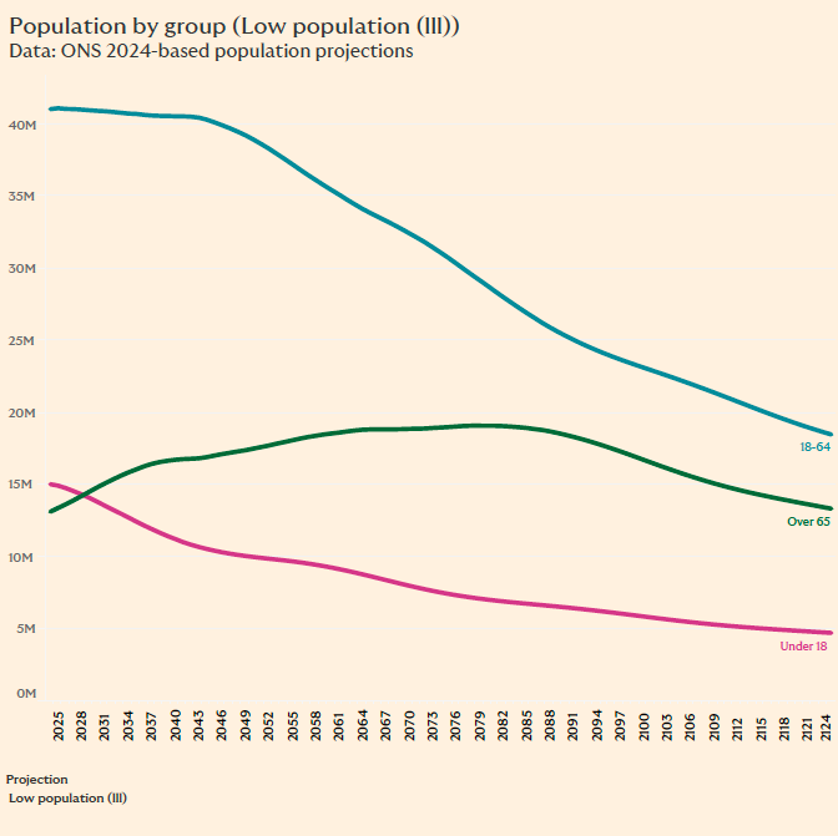
Thus, in order to sustain for this aging population the health, welfare and social care system we have established (along with all other government priorities) the economy will need to grow and become more productive. Post-18 education, whether at a traditional university, through in-work apprenticeships, or college-based, will be essential to meeting this challenge, but will itself be profoundly affected by the change.
Although, by definition, our post-18 education system potentially encompasses all adults, it is structured around demand for HE at 18. The years 2030 and 2031 represent a peak in the number of UK domiciled 18-year-olds. From this point the number is projected to fall – and then is projected to reach approximately 2016 levels by around 2040. That’s based on the principal population projection – but this shorter-term pattern can be seen in nearly all projections.
The implications are stark: 2016 is not that long ago, and at the time felt like a low point in terms of applications and offer making. But it was a year where 438,035 UK domiciled students started on a full time first degree at a provider in England, around 84 per cent of the 2024–25 figure but still the highest number on record at the time. And remember that the number of UK domiciled students available to apply will be above the number available at 2016 intake until around 2040. About 77,000 entrants is a big drop – it is equivalent to losing the eight universities with the largest number of entrants in 2024–25.
Most higher education providers have essentially three options to mitigate the impact, each with significant challenges.
- International expansion. This has been the default growth strategy for much of the sector, but it is an increasingly fragile bet. The graduate route visa has been repeatedly tightened, a new international student levy has been imposed, Biometric Compliance Assessment requirements have become more demanding, and the political direction of travel across both major parties points towards further restriction rather than liberalisation. Several institutions that built financial models around sustained international growth have already experienced sharp enrolment drops. Relying on international recruitment to backfill a domestic demographic decline is not a strategy – it is a gamble on a policy environment that is moving against you.
- Academic partnerships designed to recruit from underrepresented groups. There is real potential here, but it runs headlong into the current regulatory environment. The Office for Students’ access and participation regime has become more compliance-heavy and risk-averse, and the broader political signal around unconditional offers and recruitment practices has made institutions cautious about exactly the kind of outreach that might expand participation. Many examples of large-scale partnership recruitment have been rightly criticised for offering low quality and poorly managed higher education, which is a detriment both to the learners in question and the wider education system. Growing the domestic participation rate is the right ambition, but the policy infrastructure is not currently configured to support it in ways that also maintain the quality of provision.
- Growing vocational and mature student numbers. This has been a policy desire of multiple governments over decades, and remains largely unfulfilled. The current measure of participation rates by the age of 25 sits at around 50 per cent, and already includes work-based learning (including apprenticeships) at level 4 or above. UCAS application rates for UK domiciled 18-year-olds currently bounce around 40 to 41 per cent (down from a pandemic peak of nearly 43 per cent). The Lifelong Learning Entitlement was designed to unlock demand from older learners, but take-up has been shown to be minimal, and polling suggests the financial model is unattractive. Simply hoping that mature learners will fill the gap left by a shrinking 18-year-old cohort is not realistic without a fundamental rethink of how lifelong learning is funded and delivered.
So, while they are essential for our response to demographic shifts, our post-18 education systems will also be among the first to feel the impact of declining cohort sizes, which may cripple their capacity to do the work we need them to do.
04
How is our population changing?
In brief… ONS population projections rest on assumptions about fertility, migration, and mortality that are, in each case, more optimistic than current trends suggest – meaning the principal projection likely overstates the future 18-year-old population.
Recommendation: Government planning should stress-test against the ONS low-population-growth variant, not the principal projection, to avoid building policy on best-case demography.
The most recent available ONS population projections are based on an estimate of the population as of mid-2024, and include everyone normally resident in the UK for more than 12 months. For each age the starting population is assumed to grow or decline based on assumed net migration, and assumed mortality to produce a projection of the age one year up for the next year of projections.
A projected number of births is estimated by multiplying the average number of women at each single year of age by the fertility rate applicable to them at that age – the total number of births assumes 105 males for every 100 females, based on recent observations. The UK fertility rate has been declining since 2012 – moving from 1.94 children per woman to 1.44 in 2023. Despite this, projections do not build in a further decline – and an assumption that fertility will rise in later life is built into the principal projection.
Fertility projections also do not account for the observed effect of the place of maternal birth – we know that in 2024 34.75 per cent of all live births were to non-UK born mothers in England, and that women born outside of the UK had a fertility rate of 2.03 in 2021 compared to 1.54 for UK-born women in that year.
The principal projection for migration assumes net inward migration of around 350,000 each year – this is roughly UK net migration as observed in both 2021 and 2024 (there was a peak in between these two points of just over 900,000 in spring 2023). Beyond 2024 both estimated and observed net migration has fallen sharply (to 204,000 in June 2025) – and it is widely predicted to continue falling in future.
ONS also assumes a continued decline in mortality rates – with the current estimated mortality improvement rates of 1.1 declining slowly over the years ahead, broadly in line with recent observations. What mortality projections do not account for is recent declines in healthy life expectancy, currently at the lowest level since 2011 and projected to fall further. This tells us about future health and social care needs, and points to a likely decline in employment rates in the over 65 population. Even if people do live longer, they will have fewer healthy years ahead of them.
There are fifteen ONS population projections based on assumptions around differences in predicted changes in fertility rates, mortality rates, and migration. Mostly we hear about the principal projection, which – to me – is optimistic on all three counts. The low population growth projection assumes lower bounds change in all three categories – this appears to align with current trends and the likely interactions between them.
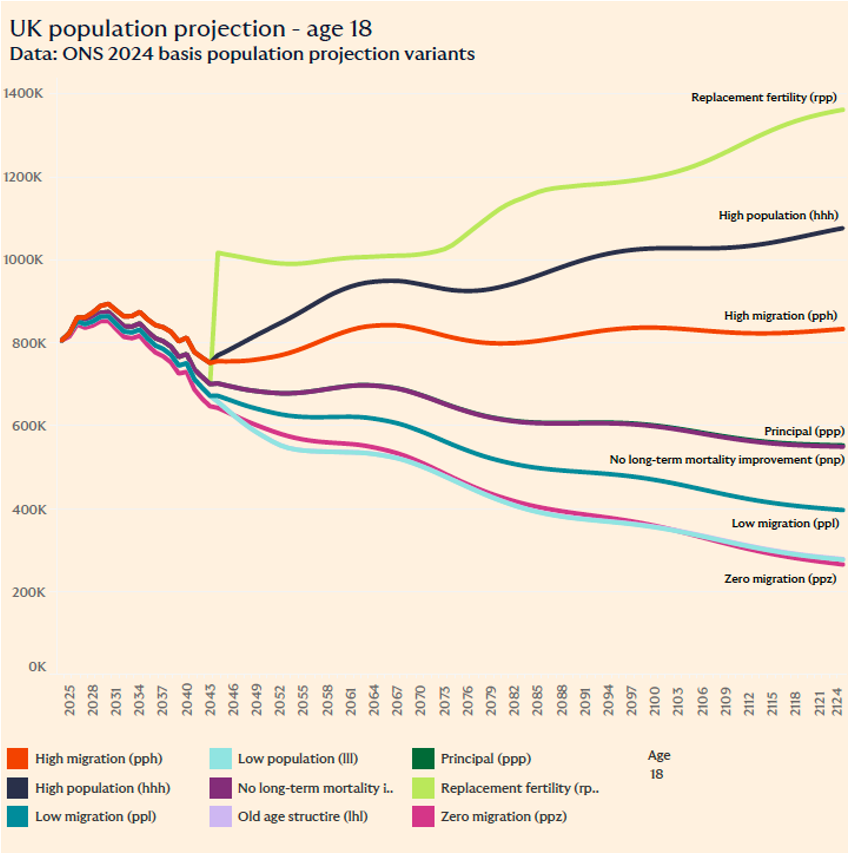
As well as being the largest and most resource-intensive aspect of the post-18 education sector, higher education is also the part of the system most dependent on student choice for its funding, because of the existence of the student loans and fees system. Given that, despite government policy attempts to rebalance provision, the demand for higher education is overwhelmingly from the 18 year old cohort, this is where the demographic impact will be felt first. The chart below shows the difference between nine of the most significant projections for that age group. What is notable is the early impact of lower assumed net migration, and the later but profound effect of lower fertility. “Replacement fertility” shows in 2044 the additional 300,000 18 year olds that would be required to keep the adult population number stable for the remainder of the period – including the birth of an extra 160,000 children in 2026.
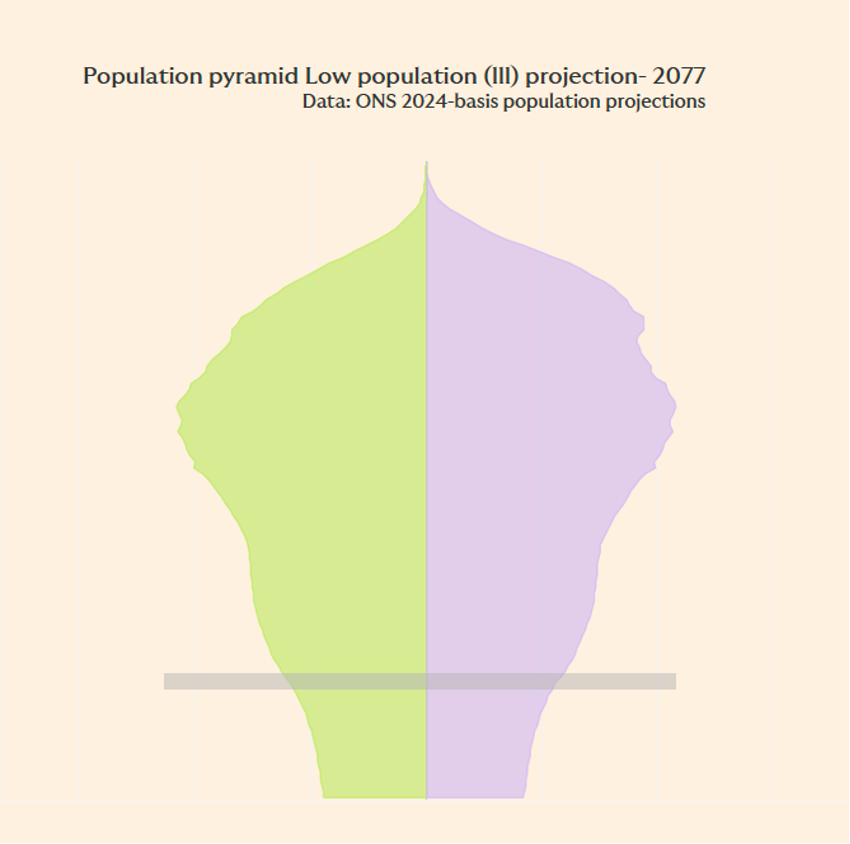
The population pyramid below illustrates the various projections through time. The grey box shows the traditional undergraduate demographic (aged 18 to 21) with the width showing the peak of the 18-year-old population around 2031.
05
Dangers to current policy programmes
In brief… Current tertiary education policy – focused on short-term skills needs, employer-shifted responsibility for training, and the Lifelong Learning Entitlement – is not designed to withstand demographic contraction, and lifelong learning cannot substitute for initial post-18 education at scale.
Recommendation: Government should use existing HE capacity to raise 18-year-old participation rates rather than relying on untested lifelong learning mechanisms to compensate for a shrinking cohort.
Current tertiary education policy in England is predicated on a desire for workplace-ready vocational skills and lifelong learning – itself an admission that a decade of market-led expansion hasn’t been the right tool to drive growth. Despite the welcome early-stage work of Skills England, planning is necessarily driven by immediate and short-term needs: what skills are needed now and will very obviously be needed in the next few years.
Planning beyond the immediate horizon is something that requires an active choice, designing our chosen future rather than reacting to known economic needs. It’s a high risk activity, and it is very easy for people to be wise after the event. Why, for example, have we had to intervene to educate more AI professionals: a part of this is because, 18 years ago we were living through an AI winter and the field had never been less fashionable. We can make some long-term predictions: healthcare and healthcare technology, environmental remediation and geoengineering, and the creative arts are likely to be solid long-term bets for the UK economy. But there’s always a danger in making these kinds of predictions – what’s also needed is flexibility.
This highlights another capacity currently being designed into the tertiary system: lifelong learning. The idea that people would retrain and upskill throughout their career is not a new one, but responsibility has shifted from employers offering training, through providers working with employers to upskill the workforce, to individuals being responsible for their own development. The Lifelong Learning Entitlement is the end point here – workers borrowing money from the government via the student loan system to fund their own personal development, and taking on all of the financial risk in the process.
It’s beyond the scope of this signal to examine the many flaws of this plan – suffice it to say that lifelong learning is not a replacement for tertiary education at 18 (it has never been clear what 18 year olds with L3 qualifications at best are meant to be doing instead) or for training in the workplace as a facet of long overdue commercial investment in workforces, systems, and tools. The current plans gesture at stackability and transferability without actually doing the implementation that needs to happen. And the loan and repayment plan is just as unattractive as the rest of student finance.
Clearly there is an ambition to grow lifelong learning (not least via the lifelong loan entitlement), but the easiest way to achieve the two-thirds of young people target against demographic headwinds would be to use existing capacity to educate more school leavers moving into a rapidly shifting economy – a tried and tested approach. However, the current state of the higher education funding model and the graduate job market will make this very difficult indeed to pull off. To illustrate this, we now look at demand for HE study, the physical capacity of the HE estate, and the likely future of the HE workforce.
06
Demand: who wants to study?
In brief… UK 18-year-old demand for HE has grown even as the cohort has shrunk, but the application rate has dipped slightly in recent years, and a significant gap persists between those who apply and those who actually enter – while government and employer demand for graduates remains strong.
Recommendation: If the two-thirds participation target is to survive demographic decline, government must remove the barriers – inadequate maintenance, unattractive loans, and a risk-averse regulatory regime – that currently prevent willing 18-year-olds from entering higher education.
How many UK domiciled 18-year-olds want to study a first degree? In recent years, this question has tended to be framed in terms of the proportion of the 18-year-old population that enter higher education.
The most common measure of higher education participation for 18-year-olds is the proportion that apply to a course via UCAS – the current application rate is 41.2 per cent. The current entry rate (the proportion of 18-year-olds who actually take up a higher education place) is 36.4 per cent. These numbers don’t represent the entirety of 18-year-old entry (they only cover applications via UCAS) but we can be confident that more people intend to start a degree at age 18 than end up doing so.
We don’t know why. The likelihood is that some fail to make the grades they need to get on the course or courses they want to do, some change their mind and go off and do something else. UCAS is understood to be actively investigating the common reasons behind these choices.
One thing we do know about UK 18-year-old demand is that it doesn’t appear to have a simple relationship to the number of 18 year olds in the UK. The numbers entering HE have grown (excepting a pandemic recovery blip) even during periods when the number of 18 year olds in the UK has fallen. Even though the proportion that enter UCAS has dipped slightly in recent years, demographics mean that the number applying via UCAS, and the number entering higher education, has grown year on year.
A note on terminology: “UK domiciled” does not just mean those who were born in the UK or UK nationals. If you are permanently resident in the UK (whether you are a UK citizen, have indefinite leave to remain, settled status, or right of abode) you are UK domiciled. Data on applicant or student nationality within the UK domicile category is rarely published.
This matters for demographic modelling because a significant proportion of “UK domiciled” 18-year-olds were born to non-UK-born parents, and patterns of participation among these groups may differ from the population average.
In thinking about demand for higher education we also need to consider the demand for graduates from the government and employers. Starmer’s desire to see two-thirds of young people hold a higher-level qualification is an example – as Tony Blair’s 50 per cent target was before it – of a broad desire to drive productivity and social mobility through a better qualified workforce.
What about employers? It is complex – for all the issues with the current graduate job market unwinding after a post-Covid boost and the shifts to hiring patterns that some predict could flow from generative AI tools, the underlying truth is that there is still a demand for graduate skills in the workforce and this is unlikely to change any time soon.
The policy implication is clear: if the government is serious about two-thirds participation, and if employer demand for graduates remains strong, then policy must actively work to raise participation rates to compensate for a shrinking cohort. That means confronting the barriers that currently prevent willing 18-year-olds from entering HE – inadequate maintenance support, an unattractive loan system, and a regulatory environment that discourages rather than encourages innovative recruitment. It also means asking whether the current fee and funding model, which was designed for a growing market, can survive in a contracting one – and what happens to institutions whose financial viability depends on volume.
07
Capacity: how many can we teach?
In brief… The HE sector currently has far more capacity than a post-2031 demographic will demand, and there is no government framework for managing the institutional contraction that will follow – meaning closures and mergers will be disorderly and will hit the most disadvantaged areas hardest.
Recommendation: The DfE should develop and publish a credible institutional transformation and restructuring programme now, before the first major provider fails, including criteria for intervention, mechanisms for managed merger, and protections for students and staff.
How many undergraduate students can our current selection of providers currently take on? The answer is surprisingly vague – and relies on assumptions about quality, the student experience, and demand.
The sector currently has around two million undergraduate students, up from around one and a half million at the turn of the millennium. Somewhere around 750,000 undergraduates of all nationalities start their studies each year, of which the majority (650,000) do so on traditional first degree courses.
There are currently 457 registered higher education providers in the UK (428 in England, 19 in Scotland, 9 in Wales, 4 in Northern Ireland), up from 171 in 2000–01. On top of this higher education is delivered in a range of FE colleges, sixth form colleges, and private providers.
There is no such thing as a total maximum carrying capacity for the sector. Each course or provider will expand or contract to serve the number of students enrolled. Any part of the current sector could expand infinitely, but the quality of the student experience – both in terms of the quality of teaching and the wider student experience, and the ability for students to access housing or other resources – would decline.
The attempts by various governments to promote university level qualifications outside of the traditional three-year degree can be seen as a more controlled attempt to balance quality and volume. Accelerated degrees aimed to reduce costs by moving young people from application to employment faster. Apprenticeships could be seen as a way to shift some of the costs of delivering provision to employers – and again shortening the space between application and contribution.
The policy implication is that the system currently has more capacity than it is likely to need by the mid-2030s. This is not, in itself, a crisis – some contraction is manageable. But unmanaged contraction is a different matter. Without a government framework for institutional restructuring, the demographic decline will produce disorderly closures and mergers, with the heaviest impact falling on institutions in areas of the country that can least afford to lose their university. The DfE needs to develop a credible transformation and restructuring programme now – not when the first institution fails. The Education Select Committee’s recent report made clear that no such protocol currently exists and that the OfS has warned that around 124 providers could run a deficit in 2025-26 without mitigating action.
08
The academic pipeline: who is available to teach?
In brief… The academic workforce is ageing, increasingly reliant on international recruitment, and facing a structural pipeline problem – fewer domestic 18-year-olds means fewer future doctoral students, which means fewer future academics, compounding the demographic decline in a self-reinforcing loop.
Recommendation: Government and UKRI should review doctoral funding to remove the personal debt barrier to academic careers, and the sector should challenge whether a PhD is the right entry requirement for all academic roles.
For the past thirty years we have experienced a glut of suitably qualified UK-domiciled applicants for academic roles. For various reasons – increasingly poor salaries and working conditions, a decline in interest in “pure” academic subjects among undergraduates, and the demographic shifts we have already talked about – this is unlikely to continue. Academia has been an aspirational career for so long it is difficult to imagine a world in which a shortage of staff would constitute a problem. But we are very nearly there.
The academic workforce is an ageing one, and includes an increasing proportion of staff domiciled overseas. With just about every industrialised country in the world expanding higher education, competition for academic staff has become more acute – for the moment the historic reputation of UK universities (and the universality of the English language) are our best assets in attracting international staff. Pay and working conditions are becoming less competitive – an issue that has already hit professional staff recruitment – and the current crisis in funding means that we are unlikely to see this change soon.
Some of the default approaches – low pay, peripatetic roles, multiple employers – may be effective for a few years but do not represent a lasting solution to a coming problem. There is a paucity of serious thinking about the role of the academic (what do we expect from staff employed to do teaching or research – and why is so much of the answer “administration” which could probably be done more effectively by dedicated staff?) or entry requirements to the profession (why do we expect such a substantial personal investment in higher degrees – with debt that would discourage all but those with access to family money – in order to carry out these jobs?). To take one concrete example: the requirement for a PhD as the entry qualification for an academic career was never designed for a world in which doctoral study carries significant personal debt and where few take up an academic role before the age of 26 – meaning that institutions are asking people to forgo eight years of earnings before they can begin their career.
With migration beginning to fall sharply – both for study and for work – academic employment cannot afford to coast on past glories.
The policy implication is that demographic decline in the student population will be accompanied by a parallel decline in the available academic workforce – and the two will interact. A smaller 18-year-old cohort means fewer future doctoral students, which means fewer future academics, which means less capacity to teach the cohort that follows; or, for that matter to perform the research that could drive growth and innovation. Government and the sector need to think seriously about how academic careers are structured, what the realistic entry requirements should be, and whether the current model of funding doctoral training through individual debt is compatible with a system that needs to sustain its own workforce pipeline.
09
What should change now
In brief… Five immediate policy actions are required – stress-testing the funding model, building an institutional restructuring framework, reforming the regulatory environment, fixing student maintenance, and intervening in the academic workforce pipeline – none of which is transformative, but all of which are necessary to prevent disorderly collapse.
Recommendation: These are the minimum actions to prevent a demographic shift that is already visible in the data from producing a chaotic and damaging contraction of the post-18 education system.
The demographic shift described in this signal is not a distant prospect. The peak of the 18-year-old population is four years away. The policy responses that will determine whether the system adapts or collapses need to begin now.
- The funding model needs to be stress-tested against a contracting market. The fee and loan system was designed for expansion. In a declining market, institutions competing for a shrinking pool of students will face a decline in revenue that the current fee cap cannot accommodate. Government should publish modelling of institutional financial sustainability under the ONS low-population-growth scenario, and should set out what it will do when – not if – providers begin to fail.
- Government needs a credible institutional restructuring framework. The absence of a protocol for university insolvency is not a gap that can be filled during a crisis. The DfE should develop and publish a transformation and restructuring programme that includes criteria for intervention, mechanisms for managed merger or closure, and protections for students and staff. The Education Select Committee’s recent report is the starting point, not the destination.
- The regulatory environment needs to support participation growth, not obstruct it. If the two-thirds target is to mean anything against demographic headwinds, the OfS should be directed to prioritise access and participation outcomes, and ensure institutions are resourced appropriately to deal with the task of teaching an expanded population of students with less successful prior experiences of education.
- Student maintenance needs to be addressed as an urgent barrier to participation. For many potential students, particularly those from lower-income households, the decision not to enter HE is driven not by tuition fees but by the impossibility of living costs. The maintenance system has been eroded by inflation and is now a binding constraint on participation. Targeted maintenance grants – as the government has begun to signal – should be introduced at scale, not as a marginal supplement.
- The academic workforce pipeline needs deliberate intervention. The current model in which entry to an academic career requires a PhD funded largely through personal debt is incompatible with sustaining the workforce the system needs. Government and UKRI should review doctoral funding with the explicit aim of ensuring that academic careers remain accessible to people from all backgrounds, and the sector should be challenged to rethink whether a PhD is genuinely the right entry qualification for all academic roles.
These are not transformative proposals. They are the minimum actions required to prevent the demographic shift from producing a disorderly and damaging contraction of the post-18 education system. The companion to this signal – exploring longer-term scenarios for higher education in a shrinking Britain – will consider what a more fundamental rethinking might look like.
Endnotes
- ONS, National Population Projections: 2024-based (28 April 2026), principal projection, UK summary tables by single year of age.
- The state pension age is currently 66 and will rise to 67 by 2028 and 68 by 2046. Throughout this paper, 65 is used as the threshold to account for the significant proportion of people who retire before the state pension age.
- Social Market Foundation, Pension Shock: Millions in Gen X are projected to have inadequate pensions (March 2026).
- ONS, Births by parents’ country of birth, England and Wales: 2023 (8 November 2024); updated in Births in England and Wales: 2024 (August 2025).
- ONS, National Population Projections: 2024-based, single year of age projections.
- HESA, Higher Education Student Statistics: UK, 2016–17, Table 1.
- Post-18 Project analysis of UCAS End of Cycle data 2024/25, DT051 Table 1 (Entrant, UK domiciled, First degree, Full-time, England; aggregate of top 8 providers).
- Home Office, Statements of Changes in Immigration Rules: HC 590 (January 2024); HC 1118 (April 2024); HC 535 (July 2024). Summary: Migration Observatory, Net Migration to the UK (updated January 2026).
- Home Office, Immigration White Paper (2025).
- OfS, Financial Sustainability of Higher Education Providers in England 2025 (May 2025; November 2025 update).
- DfE, Participation Measures in Higher Education.
- UCAS data releases. June 2025 deadline: 41.2% (down from 41.9% in 2024); January 2026 deadline: 40.7%.
- DfE, Lifelong Learning Entitlement: Overview. https://www.gov.uk/government/publications/lifelong-learning-entitlement-lle-overview/lifelong-learning-entitlement-overview
- ONS, National Population Projections: 2024-based (28 April 2026).
- ONS, National Population Projections: 2024-based, Methodology; ONS, Sex Ratios at Birth.
- ONS, Comparison of Total Fertility Rate Estimates with Projections, UK and Constituent Countries.
- ONS, Parents’ Country of Birth, England and Wales (dataset). https://www.ons.gov.uk/peoplepopulationandcommunity/birthsdeathsandmarriages/livebirths/datasets/parentscountryofbirth
- Migration Observatory, Children of Migrants in the UK. https://migrationobservatory.ox.ac.uk/resources/briefings/children-of-migrants-in-the-uk/
- ONS, National Population Projections: Migration Assumptions, 2024-based (28 April 2026).
- ONS, Long-term International Migration, Provisional: Year Ending June 2025 (27 November 2025).
- ONS, Long-term International Migration, Provisional: Year Ending June 2025.
- ONS, National Population Projections: Mortality Assumptions, 2024-based.
- ONS, Health State Life Expectancies, UK: between 2011 to 2013 and 2022 to 2024 (19 February 2026). HLE at birth: 60.7 years (males), 60.9 years (females).
- DfE, Lifelong Learning Entitlement: Overview. https://www.gov.uk/government/publications/lifelong-learning-entitlement-lle-overview/lifelong-learning-entitlement-overview
- Starmer, Labour Party Conference speech, 30 September 2025, Liverpool.
- UCAS, 30 June deadline data.
- UCAS, End of Cycle 2024/25.
- House of Commons Library, Higher Education Student Numbers, Research Briefing CBP-7857 (updated May 2026). Accompanying dataset: Summary of applicants and accepted applicants to higher education via UCAS 1994–2025. https://commonslibrary.parliament.uk/research-briefings/cbp-7857/
- Prospects (HECSU), Graduate Market Reports.
- DfE, Employer Skills Survey 2024. https://explore-education-statistics.service.gov.uk/find-statistics/employer-skills-survey/2024
- HESA, Higher Education Student Statistics (time series).
- HESA, Higher Education Student Statistics: UK, 2024/25.
- OfS Register; HESA coverage notes. HESA, historical provider data.
- DfE, Accelerated Degrees: Regulations and Guidance (2019 onwards).
- OfS, Financial Sustainability of Higher Education Providers in England 2026. https://www.officeforstudents.org.uk/publications/financial-sustainability-of-higher-education-providers-in-england-2026/ Also: House of Commons Education Committee, HC 807 (May 2026). https://publications.parliament.uk/pa/cm5901/cmselect/cmeduc/807/report.html
- UCU pay and conditions reports; OfS Financial Sustainability report on professional staff recruitment challenges.
- HESA, Higher Education Staff Statistics: UK, 2023/24 (January 2025). https://www.hesa.ac.uk/news/28-01-2025/sb270-higher-education-staff-statistics
- HESA, Higher Education Staff Statistics: UK, 2023/24. 66% UK nationality; 15% EU; 18% non-EU. https://www.hesa.ac.uk/news/28-01-2025/higher-education-staff-statistics-and-data-202324
- UCU/UCEA data; OfS Financial Sustainability report.
- Prospects, PhD Loans. UK Doctoral Loan up to £31,122 (2026/27). https://www.prospects.ac.uk/postgraduate-study/funding-postgraduate-study/phd-loans/
- HESA, Higher Education Staff Statistics: UK, 2023/24, Figure 5. https://www.hesa.ac.uk/data-and-analysis/sb274/figure-5
- ONS, Long-term International Migration, Provisional: Year Ending June 2025 (November 2025).
- ONS, National Population Projections: 2024-based, Low Population Growth variant.
- House of Commons Education Committee, HC 807 (May 2026).
- Sutton Trust, Cost of Living and University Students (January 2023; updated March 2023). Savanta polling of 1,050 students. https://www.suttontrust.com/our-research/cost-of-living-and-university-students-2023/
- British Academy, Written Evidence to the Education Committee: Higher Education and Funding: Threat of Insolvency and International Students (HEF0051), 31 July 2025. https://committees.parliament.uk/writtenevidence/144859/pdf/