Blood, debt, toil, and arrears: why thirty years of policy struggle has left us without the higher education system we deserve
In his first paper for The Post-18 Project, director John Blake argues that thirty years on, the post-Dearing settlement has failed by every measure its architects set for it – and a comprehensive review of post-18 education, from universities to in-work training, is the only way out.
Date:
Author:
01
Executive summary
The top line
English higher education is in crisis – but the crisis is not primarily financial, nor is it about AI, Brexit, or any single policy failure. The fundamental problem is that the relationship between the English state and higher education – what this paper terms the “HE/state nexus” – is broken. For thirty years, successive governments have attempted to manage the system through a single mechanism: student choice driving competition between providers. This mechanism has failed, by every metric its architects set for it, and its failure is structural, not incidental.
The diagnostic framework
This paper applies to higher education a diagnostic framework developed by Tim Oates for analysing school systems. The framework identifies fourteen control factors – including funding, accountability, curriculum, pedagogy, assessment, institutional forms, governance, and information and guidance – that must be managed in coherent alignment for any education system to succeed. Applied to higher education, the framework reveals that student choice was not one control factor among fourteen – it was a single mechanism substituted for the distinct management of at least five of them, while others were largely ignored. The result is a system that lacks not only coherence, but even a conceptualisation of the factors that would need to be aligned for it to work.
What the paper finds
The paper examines each control factor in turn. Its principal findings include:
- Funding has gone nowhere. Per-student funding has returned to its pre-Dearing level in real terms – approximately £10,000 – despite the entire purpose of the fee system being to increase it. The system that was supposed to insure higher education against Treasury penny-pinching actually put the sector at the mercy of government accountants.
- Student choice has not driven up teaching quality. By shifting the vast majority of university funding into the hands of the aggregate decisions of 17-year-olds, the English system of choice has become, more or less, an enormous machine for finding out who has the best (or best resourced) marketing department, with some world-leading research sprinkled in certain places.
- The price mechanism is broken. Every institution charges the maximum fee, every time, because the architecture of the system divorced the sticker price from the experienced cost. David Willetts insisted the £9,000 fee would apply only “in exceptional circumstances”; by 2014, all but two of 123 universities charged it for at least some courses.
- The system’s greatest claimed achievement – widened access – was not produced by the system. The demand for massification was already there; what the system was supposed to do was channel that demand into better outcomes. On that measure, the record is far weaker.
- Guidance has been systematically built up and torn down. AimHigher established 42 area partnerships and seven years of accumulated relationships, expertise, and trust with schools. It was abolished, with a three-year gap before anything replaced it. Its successors have been progressively defunded. Where public guidance has been defunded, the market has sent salespeople, not advisers.
- The franchise crisis was the system working as designed. When the only tool for managing institutional diversity is the market, the market produces the forms that maximise revenue, not the forms that maximise learning.
- The Office for Students (OfS) has been set an impossible task. It was told to be a market regulator in a system where the market does not function as a market: the price is fixed, the customer cannot easily switch provider, and the information asymmetries between institution and applicant are vast. Each new function added to its remit represents another turn of Achtenhagen’s “cycle of planned failure.”
- Pedagogy, curriculum, and professional development have been largely ignored. A world-leading researcher with no training in pedagogy can be put in front of 300 first-year students, and the system has no mechanism even to know this is happening, let alone to address it.
- Where the system does approach coherence, the results are genuinely world-leading… Research funding, governed by the Haldane principle and managed through expert-mediated accountability, has produced a system where UK research output is cited 54 per cent more than the global average. This provides the strongest evidence that another way of managing higher education is possible.
- … but the lessons of that system are ignored for most of the work HE does. The architects of the post-Dearing settlement left untouched – and, through HERA 2017, statutorily reinforced – the non-market architecture of research funding. They applied the logic of choice and competition to teaching with total commitment, but stopped at the door of research, because they knew the research system worked and would not survive being broken. The question this paper asks is why teaching was not afforded the same respect.
The heterogeneity question
Any comprehensive review must explicitly address whether a broadly homogeneous system – in which all universities are treated as essentially the same kind of institution, subject to the same regulatory framework and funded through the same mechanism – can be sustained, or whether policy should accommodate the differentiated institutional landscape that is already emerging. The system currently pretends that a research-intensive university with a £1 billion turnover, a specialist arts conservatoire with 500 students, and a large teaching-only private provider operating across multiple geographies are the same kind of entity. They are not, and governing them as though they are produces dysfunction in both.
What the paper proposes
The paper proposes a governance concordat – a transparent, negotiated settlement between the state, the sector, and students about who is responsible for what, by what mechanisms, with what limits, and with what processes for resolving disputes. This concordat should be the first product of a new comprehensive review of the purposes, shape, structure, size and funding of post-18 education, encompassing higher education, further education, and in-work technical training.
The review must not be a funding review. Funding is one of fourteen factors. A commission that treats it as the only one will produce another sticking plaster.
Seventeen interim recommendations are made, at least one per control factor, none requiring primary legislation, all achievable within the current parliament. These measures are not solutions; they are the diagnostic groundwork and pre-emptive action to enhance the quality of the review and to ensure there is enough of a system left to review.
The bottom line
The post-Dearing project failed – not because it was implemented badly, although it was; not because it was underfunded, although it was.
It failed because its mechanics were broken from the start.
Like a badly-wired plug, it operated, but the longer it did so, the more likely it would spark. The current financial state of the sector suggests that, somewhere, the fire has already begun.
English higher education has demonstrated that it has the power to change lives, enhance communities, spread prosperity, and stimulate transformation. But everywhere those benefits are achieved, it is in spite of the state/HE nexus, not because of it; driven by the altruism of public service, not the advancement of private interest.
With the hard-won learning of the past three decades, we should start again: a new review, a new policy framework, and a better chance for establishing a post-18 system that truly works for the common good.
02
Introduction: Thirty years on…
Thirty years ago, the Dearing commission was set up to make recommendations on how the purposes, shape, structure, size and funding of post-18 education, including support for students, should develop to meet the needs of the United Kingdom in the following decades. Its report established the foundations of a broad-based political consensus, that greater competition for students was the proper instrument for transforming English higher education, which has been accepted, in one form or another, by every governing party since the millennium.
The English state elevated student choice and competition between providers into organising principles for the system, such that no other tools or further justifications were considered necessary.
Thirty years of blood, debt, toil, and arrears later, it is clear these gods have failed, and we must replace them. The tools enabling competition have left the system disordered, overburdened, and effectively bankrupt. Worse, this happened precisely because of those tools, not in spite of them. The political class enlisted the youth of England as their agents of change in universities, and they got more than they had dreamed, and almost nothing they wanted.
A new system must be created, one which is politically palatable, financially sustainable, and educationally sound. But even these features, while necessary, are not sufficient. The full scope of the relationship between the English state and, not just universities, not just all providers of higher education, but all those involved in the post-18 education system, including further education and in-work training, needs to be properly codified, made transparent, and provide meaningful ways to hold all those who are part of it, including agents of the state, to account.
This is not a temporary aberration brought on by a change in government, or the advent of generative AI, or post-Brexit hangover, or policy-political Long Covid. It will not fade away with time, it will not self-correct, and while there are short-term policy fixes to diminish the fury of the graduates and the crisis of institutions (and government should enact them), there can be no long-term answer for the entirety of post-18 education which does not grapple with the deformity of the relationship between higher education and the state.
There are actions that can and should be taken now (and this paper will propose them) but to build the system the country needs and deserves will be the work of many, over an extended period. Changes to the funding model will only be one aspect of the necessary transformation and any measures will only be sticking plasters on an open wound, if a new, thorough and holistic assessment of the state of higher education, and further education, and in-work technical training is not undertaken.
This paper sets out to explain why we must change, provide a framework for what must be considered by a commission, and propose viable interim measures to ensure that our post-18 system, and the students it serves, are prepared for the challenges of the next 30 years.
03
Dysfunction and dependency: the travails of the English HE/state nexus
Today, English higher education is in a bad way – institutions are setting deficit budgets, free speech disputes have become regular headlines, and the benefits of it to those who’ve received it are being questioned. In the past weeks, the system by which higher education in England is primarily funded – the system of student loans to pay fees – has come under sustained attack from across the political spectrum, in a wide range of media, and has been a hot topic amongst graduates themselves.
Current travails are no doubt real and knotty, but they are symptoms of the dysfunction, not its cause. At its heart, all these problems, and a considerable number more, are a function of the incoherence of the inter-related, and over-lapping interactions, duties, and dependencies between the English state and the higher education system, what I term in this paper “the English HE/state nexus.”
For reasons of history, function, efficiency and democracy, higher education is both bound to the state and necessarily at a distance from it. The free creation, curation, and communication of knowledge is a good in itself in all human society, but in a constitutional democracy, such work also has a higher function, as one of the essential checks on the power of the state. It is no accident that wherever authoritarians arise, higher education is always one of their first targets.
Beyond its democratic function, higher learning is also a vital contributor to the training of technical professionals, and today in England encompasses much more than traditional conceptions of “university” might suggest. Over 100 universities make up the bulk of the English higher education sector, but there are also smaller, specialist institutions, including cultural conservatoires, professional training providers, and further education colleges offering degrees and other higher-level credentials. Higher education is profoundly important for individual, economic, and democratic health.
To sustain such a function in a modern society is not only extremely costly, but places the majority of our nation’s young people in the hands of institutions set at a distance from the state between the end of compulsory education and the beginning of their working lives, and gives such institutions a central role in local, regional and national economic life. Expense, influence, and investment are all areas where the state has a legitimate interest in holding any whose actions affect its citizens to account.
So higher education needs the state, and the state needs higher education, and both have legitimate cases that their core functions require, on the one hand distance from direct oversight (the sector), and on the other, powers to ensure accountability and responsiveness (the state).
There is no set formula for answering this question; it is necessarily a matter of dialogue. How successfully that dialogue leads to useful calibration of the distance between the state and higher education is the essential question for building a viable higher education system fit for the current age.
On what matters ought the sector to be autonomous – all or only some, and if some, in what combination? What forms of accountability ought to apply, to whom, judged by what metrics? What happens if either the state or the sector exceeds the bounds of the agreements between them?
As the examples we opened with demonstrate, the calibration exercise is currently not working: the nexus of state and sector is broken. And broken in a way that impacts well beyond England’s universities. Those aspects of post-school provision that are not funded, regulated, or discussed as part of HE but are linked to or provided by institutions inside the wider HE system have drawn further education and in-work technical training into the gravity well of the HE/state nexus.
The entire post-18 education system, even where other aspects are operating well by the metrics of their own eco-systems, is infected if the higher education system is dysfunctional.
This paper argues that a nexus failing as the English one is requires comprehensive replacement, not cursory repair. Such expansive reformation is not impossible in England, because the current nexus is the result of such forces. The past 30 years represent a distinct period of state/HE engagement, deliberately constructed to be different from preceding arrangements, based on a consensus which all major English parties elected to the Commons before 2024 have been part of: “[t]he ends of higher education and the needs of society will be best served if funding for institutions comes increasingly through the choices of well-informed individual students.”
Of course, it is not the case that market tools only appeared in English HE with the Dearing review and its impacts: England has had two universities to choose from for eight centuries, and at least one new institution of higher learning every decade since the 1820s, and it has been an accepted feature of English law for more than a century that university students have a contract with their institution. The tools of the market have been part of English HE for a long time. However, since the turn of the century, and through cross-party consensus, choice and competition have not been “aspects of the system” – they have become the organising principles.
But, as organising principles, they are deficient. We know this because every governing party has taken at least one turn in using these principles to build a white paper, subsequent legislation, and then a review of why things are not working as intended:
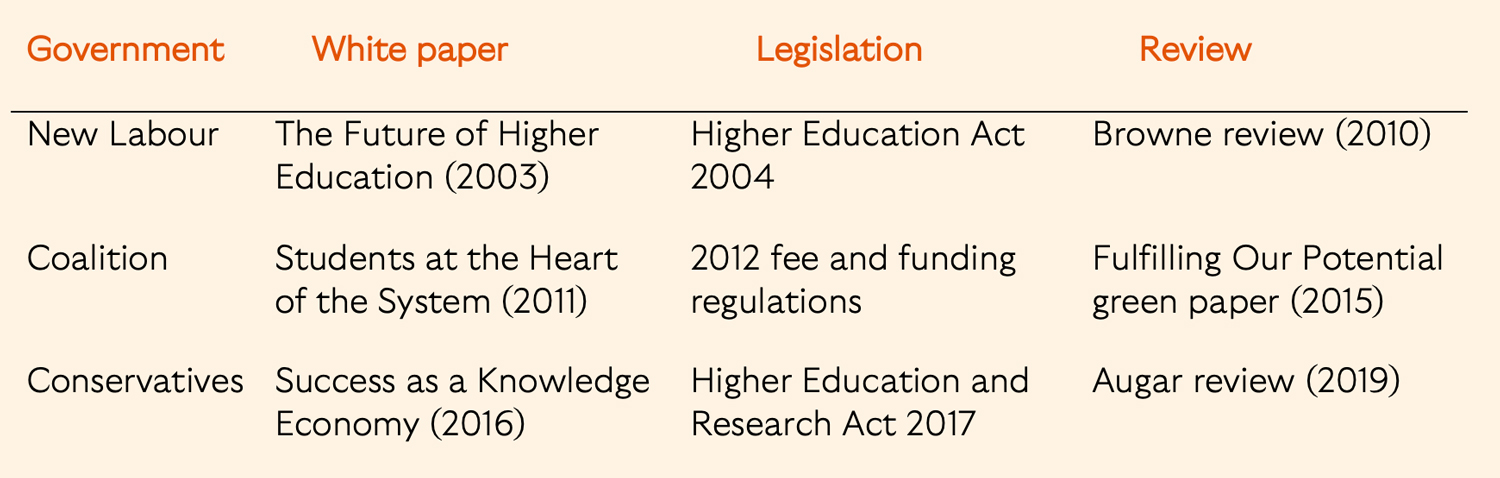
The current Labour government has reached white paper stage, although no legislation has yet been announced. That white paper criticises the present system, but unless the legislation it leads to addresses the underlying problem in how the state conceives of both its own and education providers’ functions, processes, rights and duties in regard to higher learning for citizens, it will be impossible to build capable, credible, enduring governance and accountability mechanisms. Without codified systems in which tensions between the state and the sector can be debated and resolved, the system will continue to fail.
But there is a model available for how to build a more successful nexus between HE and the state, drawn from analysis not of other HE systems, but of successful school systems across the world.
04
Under-theorised and over-active: the current English HE/state nexus in action
Tim Oates has put forward an analysis of the English school system which has proved to have enduring influence in this country and abroad. Oates argues that successful school systems are distinguished by, firstly, having clear, enduring, and appropriate control of fourteen different factors, and secondly, implementing such control with primary focus on the interaction between those factors. That is, no single factor determines whether a school system will work; instead it is whether all the factors have been deliberately aligned in such a way that they interact in more-or-less predictable and productive ways. Close attention to these factors and the relations between them achieves “coherence”, and it is the coherence of the system, not any of the choices about the individual factors, which marks the successful out from their peers.
The fourteen control factors are:
1. Curriculum content – national standards, subject specifications, textbooks, schemes of work, sequencing
2. Pedagogy – teaching and learning approaches, models of ability and progression, setting/streaming, homework
3. Assessment and qualifications – summative, formative, diagnostic; teacher vs external assessment; measurement models
4. Institutional development – leadership, management models, lesson observation, dissemination of good practice
5. Institutional forms and structures – school/institution size, type, phase, class size, facilities, collaboration/competition
6. Governance – national control arrangements, inter-departmental collaboration, governance tiers and powers
7. Professional development – teacher selection, training, CPD, remuneration, performance measurement, unionisation
8. Accountability – targets, data collection, publication, consequences, sanctions
9. Inspection – framework, frequency, composition of inspectorate, governance of inspection
10. Funding – levels, patterns, sources, allocation, financial control, links to accountability
11. National framework – legal attendance requirements, routes in education/training, allocation points, route flows, transfer arrangements
12. Selection and gatekeeping – methods of allocation to routes, entry requirements, equivalence rules
13. Information and guidance – focus and detail of guidance, entitlement to services, links between institutions and destinations
14. Allied social measures – fiscal policy incentives, family support, regional development, health services, labour market policy
Although any list of the factors necessarily requires they be in some form of order, the order is not a priority listing. Again, it is the relations between the factors that is significant, not any one of the factors.
Alongside the factors, Oates also lays out six explanatory factors, which are not levers the system can move itself, but instead establish the states of affairs in which a system operates: global economy, domestic economy, culture, political structures, historical contingencies, and natural environment.
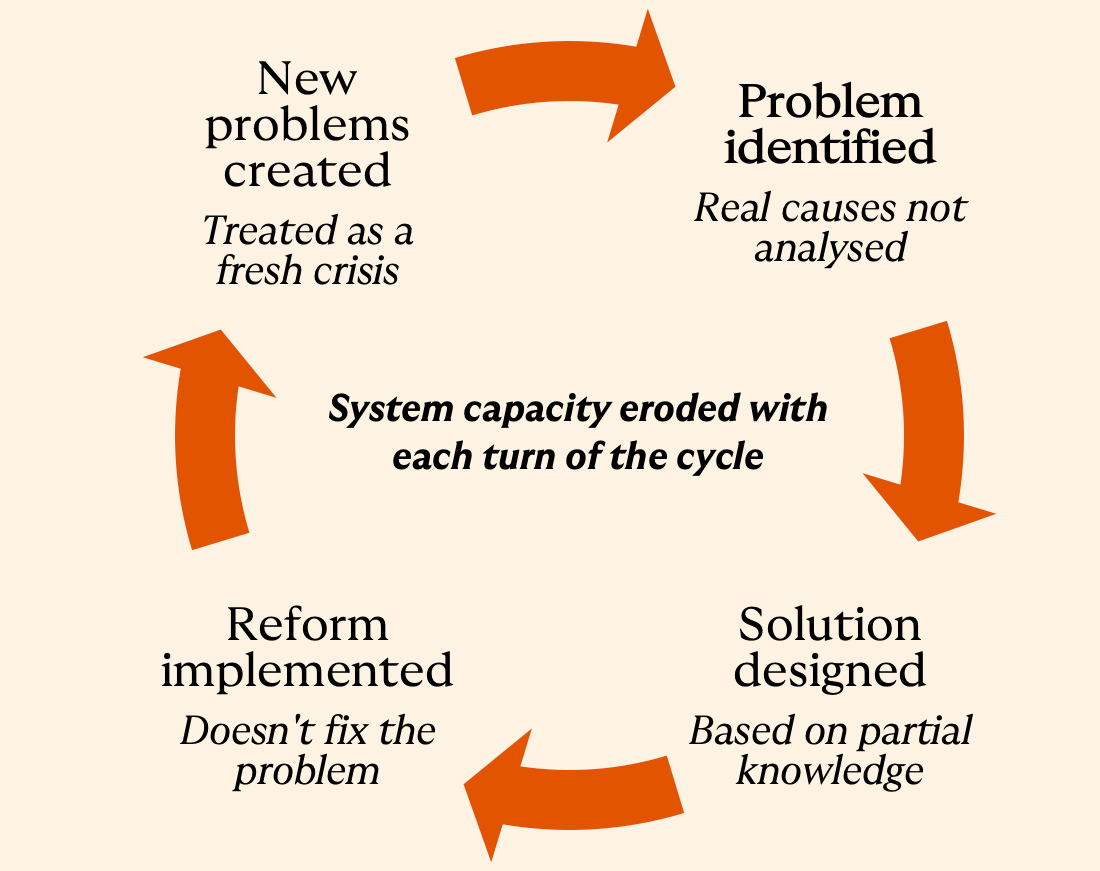
As well as setting out the control factors, Oates also draws on an insight from German educational researcher Frank Achtenhagen, who outlined a model of the dysfunctional policy cycle he called “the cycle of planned failure.” Absent a proper appreciation of the value of coherence, and measures to ensure it was in place, Oates argued, school systems would be trapped in this cycle.
Codified into A Cambridge Approach to Improving Education, the framework is based on evidence from detailed case studies of England (the original primary subject), Finland (subject to particularly intensive historical analysis, correcting some profound errors of ahistorical analysis), Singapore, and Massachusetts. Subsequently, Hong Kong and Alberta, Canada have also been made subject to deep case-studies.
Beyond these deep cases, substantial comparative analysis covered Japan, South Korea, Taiwan, Germany, France, Flanders (Belgium), Australia, New Zealand, and the United States at national level. In 2021, coverage was expanded to include Chile, Estonia, Poland, Portugal, and Spain, explicitly citing curriculum coherence as a key explanatory factor across all ten country analyses. The Centre for Education Systems (CES), which directly draws on Oates’s framework, compares all four UK nations plus ten international jurisdictions. Through Cambridge Partnership for Education, the framework’s principles have been deployed in partnerships with governments in Gujarat (India), Uzbekistan, Malaysia, Ethiopia, Panama, Oman, Qatar, Egypt, Sweden, Vietnam, Rwanda, Bahrain, and others – reaching over 49 million learners in more than 40 countries.
The framework’s most thoroughly documented impact is on England’s 2014 National Curriculum, which is perhaps not a surprise because Oates chaired the four-member Expert Panel. The panel’s report directly embedded the control factors analysis, and concrete policy changes followed, but the framework has endured through a change in government that otherwise brought strong critics of the previous government’s approach into power. The 2025 Francis Curriculum and Assessment Review stated that “the previous review, whose expert panel was chaired by Tim Oates, did exceptionally high-quality work that has largely stood the test of time” and affirmed that the broad structure it set out would remain the same.
The control factors framework can therefore be seen as an academic analytical tool with direct, documented, and durable policy impact. Even critics of the implications Oates drew from it have not challenged the value of the framework for explaining differences in the level of success of school systems.
What has not yet happened has been any sustained application of the framework to higher education. This is not surprising, because the framework was explicitly developed for school-level/compulsory education, and every case study, data source, and example concerns primary and secondary schooling. The theoretical foundations – Schmidt and Prawat’s curriculum coherence concept, TIMSS and PISA data – are exclusively school-level assessments. However, attempts to apply aspects of its theoretical antecedent to HE have been made: “curriculum coherence” has been explored independently in HE contexts, notably by Bateman et al., Fung on connected curriculum, and Muller using neo-Bernsteinian theory, but none of these studies use Oates’s specific control factors framework. Pountney cites both Oates and HE sources on coherence but does not apply the fourteen factors to universities.
However, the control factor analysis can provide real insight into the problems of the current English HE/state nexus, and point the way towards enduring solutions. Although the framework’s original objects of study – national curriculum, approved textbooks, school inspection, standardised testing – are specific to compulsory education, the framework itself does not have to be. The framework is not prescriptive but diagnostic, and thus, while higher education’s institutional autonomy and academic freedom operate very differently from the compulsory school systems the original work describes, considering all of the factors and their relations can be used to review any form of education system. The framework does not require the control factors to be managed in a specific way, by a centralised state for example; it requires only that somewhere within the system the factors and the relationship between them is understood.
The factors do not need to be controlled through top-down mechanisms – indeed, Schmidt and Prawat’s key insight was that even when all these factors appeared to be nominally in the hands of the state, coherence was not guaranteed if they were not properly aligned. What the factors must be is controlled in some way – whether by a capable agency or through distributed arrangements – with the processes and impacts of that control considered in light of how they interact with the other factors. Schmidt and Prawat’s central insight is that there is no necessary relation between political form and coherence: Singapore’s directive-consensual model, Finland’s participatory-democratic model, and Massachusetts’ distributed model have all produced coherent systems through very different mechanisms. What matters is that somewhere in the system, the work of alignment is being done, and that somebody is watching whether it is being done well.
Utilising the framework, it becomes clear that the English HE/state nexus not only lacks coherence, but even a conceptualisation of the control factors as distinct aspects of the system that need to be brought into coherence.
For the past thirty years, the nearest thing to such a conceptualisation has been assumptions about the benefits of student choice and competition between providers. Given the framework has not previously been applied to HE, it is not a surprise that the system’s designers did not deploy it in their architecture, but using this lens to review the system demonstrates why it has been so unstable and unsuccessful.
Choice and competition are not a control factor – they are a single mechanism that was substituted for the distinct management of several control factors, while others were largely ignored. To avoid repetition, the below considers the control factors in groups:
A. Structural: funding, accountability, inspection, institutional forms and structures, national frameworks
B. Navigational: selection and gatekeeping, and information and guidance
C. Institutional: institutional development, professional development
D. Educational: curriculum content, pedagogy, assessment and qualifications
Lastly, I will consider the outstanding control factor, governance, and explore why this is especially important in a higher education/state nexus, and briefly consider why research, a function of HE that no school system has, provides further evidence of the value of the framework and the weakness of the present nexus.
05
Structural control factors
Funding
Funding has dominated the conversation about English HE in this period. Although Dearing’s remit was wide, the immediate cause of the review was, fundamentally, financial – per-student funding in English HE had halved during the 1979–1997 Conservative government. Above and beyond all other things, that universities (of which there were now significantly more than in 1979 as a result of the abolition of the polytechnic/university divide) were underfunded was a political given, even by the government itself. Convened by the Conservatives and accepted by New Labour, Dearing said funding should come “increasingly through the choices of well-informed individual students”, and subsequent policymakers reinforced this principle at every turn: for example, under Vince Cable, then-Liberal Democrat secretary of state with responsibility for higher education, the 2011 white paper committed to “deliver a more responsive higher education sector in which funding follows the decisions of learners and successful institutions are freed to thrive”.
However, the way student choice and funding would interact was through a complex mechanism, created to resolve what was generally agreed at the time was a wicked problem. Growth in student numbers was not considered reversible – it was widely held that more higher education would, more-or-less automatically, engender more economic growth. Therefore, any new system needed to provide for enhanced funding on an enduring basis for an expanded population of students. But it was argued, politicians would never privilege higher education over other aspects of the education or wider government budget, such as early years education or children’s health.
To match and then improve the available funding for a growing system, Dearing concluded it was therefore necessary to raise additional funds not from the general taxpayer, but instead from those directly engaging with HE. But traditionally higher education was undertaken by people at the beginning of their careers, when they had no capital to spend on the education necessary to make them into people likely to generate enough capital to pay for their education.
Nicholas Barr proposed an elegant solution: a sort-of reverse pension, by which students would get HE for free, and graduates would pay for it, in proportion to the benefits they derived. Students would borrow the necessary capital from their older, graduate (and therefore generally richer) selves by taking out loans that did not have to be repaid until the individual was earning, and where the amount paid off per month was a portion of the earnings, not of the debt. Because such loans would never be offered on the open market, this system required government to underwrite the system, using the Student Loans Company (created for a much more limited loan function a decade before) to send the fee money directly to HE institutions, and maintenance loans (for living costs) directly to students. Because government was neither prepared to write an entirely blank cheque to universities, nor risk deterring young people from disadvantaged backgrounds from accessing HE, a limit was put on the amount of fee that could be charged: in 2004, £3,000; in 2012, rising to £9,000. Limits were also placed on the amount of money which could be borrowed for living costs.
Despite its technocratic neatness, thirty years after Dearing, this funding system has left us exactly where we started. In 1997, per-student funding was worth about £4,608 per year at 1995–96 prices – a little over £10,000 in today’s money. In the 2025–26 academic year, a domestic student paid £9,535 per year in fees, which when added to other government grants, means per-student funding today of… a little over £10,000. Too little attention has been given to this: the very reason for Dearing and building a new fee-based system has failed. One does not need to blame those who tried to make it work – it was not always obvious it would fail. But by the standard it set itself, it most definitely has.
In fact, it is worse than that, since the demographic composition of English higher education has changed across those thirty years, and now includes more full-time students from a wider range of backgrounds who both need and deserve additional resources to teach and properly support. Moreover, the English state has persisted in underfunding its research demands to the sector – arguably, part of the point of any fees uplift was to not only improve funding to teaching, but also to cross-subsidise research. It is a mark of the failure of this ambition that no one now suggests this is a purpose of the domestic fee, instead ascribing this role to international students’ payments (itself a dubious contention, as we shall see below).
Thus, the domestic student funding situation has oscillated, only to return to precisely where it started, while the likely costs have expanded. English HE now needs to do a lot more with a unit of resource from domestic students nearly identical to that which it had at a point where almost everyone agreed the system was in crisis. Looking at this with an eye on system coherence, we can see further evidence of meshing together multiple control factors through a single mechanism, and therefore achieving none of them. Not only did the system not result in substantial and sustained additional funds to higher education in perpetuity beyond what could ordinarily be raised by general taxation, it actually baked this outcome into the system itself, through the interrelation of two different aspects of the fee/loan process.
The first issue was that almost every institution charged the full viable fee amount, almost immediately, every time they could. Governments of all parties persistently asserted that government-set loan amounts should be a ceiling, not a standard, price: David Willetts, higher education minister at the time of the 2012 increase, insisted that the £9,000 fee would apply only “in exceptional circumstances,” despite the fact that every institution had more or less immediately moved to charge £3,000 in 2004. This ought to have been predicted, because the architecture of the fee broke the price mechanism. For students, HE was free at the point of delivery and what students borrowed (in so far as they really understood what that amount meant, and what it would look like to pay it back when they were working, on which see below) had only an incidental relationship to what the graduate would pay back.
The customer was the aspirant student, not the graduate (not even the actual student attending the institution, since mechanisms for moving provider remain exceptional). There is thus no incentive for institutions to differentiate their offer through price, because the intended customer has no compelling reason to choose a lower-fee institution. Indeed, it swiftly became clear that those offering “cheaper” degrees were losing out, because students doubted the quality of anything being offered at a discount rate in a “market” where the standard price was “everything students could borrow”. Since 2012, the Teaching Excellence Framework (TEF) has added a small additional level of fee differentiation for those institutions without a TEF judgement as against those with one, and again, amongst those entitled to charge higher, everyone has chosen to do so. Precisely because the amount borrowed is only relevant as the top limit of what is to be repaid (subject to inflation, of course, though how this is calculated is its own vexed question for the system), the sticker price and the experienced cost are divorced from each other.
Because the initial outlay of money by the student to the university was funded directly by the state, once it became clear that the level set by government would be the default, the Treasury proved extremely resistant to raising the limit, and thus the fee lingered at a level below its real-term value for most years, until we reached the position that the total domestic per-student funding is the same now as in 1995.
But this was not the only unintended consequence of the funding model. The Resource Accounting and Budget (RAB) charge – the money the Treasury believes it will not see again as a result of underwriting the student loans system – has also been dramatically squeezed. Today, the RAB charge ought to represent the overwhelming majority of government subsidy to HE for teaching, but the Treasury’s willingness to bear this burden decreased significantly over time. Sums of money that, when they had appeared on educational department balance sheets as grants, appeared defensible, were no longer so when they showed up as “bad debt” in the government’s accounts. One did not have to be an arch-Thatcherite to look at sizeable loan write-offs and consider them to be peculiar, and indeed, both Tory and Labour chancellors took steps that reduced the RAB charge through the only mechanism available – changing the terms of the student loans system. The repayment threshold (the point at which graduates were earning enough money to have to pay into the system) was held below inflation, drawing more and more lower-paid, early-career graduates into making repayments.
Under Rishi Sunak, a new “Plan 5” system was created which meant new students would repay for 40 years, not 30 as their older siblings were expected to. The Treasury now expects to make money out of the student loan system, and because of the nature of government accounting, is incentivised to do so. The very system that was supposed to insure higher education against Treasury penny-pinching actually put the sector at the mercy of government accountants.
Where a genuine infusion of additional cash does seem to have been found is from international students. Numbers have grown and generally brought with them corresponding, much higher fees. It is true that far more international students attend English higher education today than in the 1990s, and the total monetary value of their fees is about the same as the total provided by their domestic counterparts. This was never envisaged as part of the post-Dearing system (in so far as international students were considered within the various reviews at all, it was imagined their numbers would grow relatively slowly) but it might be argued it is evidence the system can self-stabilise in innovative ways.
However, the actual sums do not really stack up to support that claim. The additional income is significant, but fundamentally, it comes from an increased number of students, so is diffused across the system – so whilst there now is cross-subsidy from international students to domestic students, it amounts to around £2,500 per year, suggesting an overall per-student spend in HE of £12,000 to £13,000; an increase against the 1990s, yes, but not extraordinarily so. More problematically, that average obscures that the distribution of international students has, until relatively recently, been clustered in highly selective institutions, who were already the most financially advantaged under the former system. Where international student numbers have grown in other parts of the sector, they have tended to be at price points largely the same as domestic students, in a manner which has attracted negative attention from the Home Office and the regulator.
Accountability and inspection
If the funding mechanism failed by its own metrics, it also led to deficiencies in other control factors. For example, student choice in the post-Dearing system was also supposed to provide an accountability feedback loop which would drive enhanced quality. In their reform of the system in 2004, New Labour introduced the National Student Survey (NSS), and Browne, convened by Labour but reporting to the Conservatives, doubled down on the link between student satisfaction and accountability, with an entire section titled bluntly, “Student choice will drive up quality”.
Education quality is notoriously difficult to determine, especially by users of any education system. In fact, Dearing mostly directly equated quality with per-student funding, but we have seen how that panned out. Instead, let us first consider the metric the system established for itself, the NSS. Conducted annually since 2005, its data does indeed suggest there has been a steady positive increase in students’ satisfaction with higher education.
However, the NSS is not a reliable or even especially useful instrument. In the first place, determining the quality of teaching is a demanding and complex task, which is why the school inspectorate Ofsted stopped making judgements about the quality of individual lesson observations nearly a decade ago – students’ expressed satisfaction one way or another does not demonstrate that good teaching has happened. There is considerable evidence for systemic biases in teaching satisfaction surveys elsewhere, and repeated reports across the system of attempts by HE providers to play on the high-stakes nature of NSS outcomes to induce students to provide positive feedback.
Even so, students could give us some idea whether what they got out of higher education was what they had expected, but this is not something the NSS can tell us, because there is no cohort-by-cohort comparison of what students are satisfied with, because they are not asked about their expectations upon entry. The steady improvements in satisfaction suggested by the NSS might simply reflect very different views by each cohort of what ought to be considered satisfactory. As either an objective or a subjective measure of satisfaction, the NSS is deeply flawed.
Moreover, there is evidence elsewhere that students are not satisfied. Recent work by Nicola Dandridge (who was chief executive of OfS when it took on responsibility for the NSS) suggests that significant numbers of undergraduates, and a still larger proportion of recent graduates, would have changed some aspect of their HE experience if they were to undertake it again. Elsewhere, students taking their universities to court over their treatment during Covid or at times of industrial action, or the growing number and nature of complaints making it to the Office of the Independent Adjudicator, suggest there is real unhappiness amongst students. This is not evidence that these students wish they had not undertaken higher education. Instead, it suggests that they wanted, and believed they were being offered, something better than what they got. For a system badged with “students at the heart,” this cannot be considered a success, but it also should not be a surprise.
Although the nexus has tended to assert that choice must drive quality, the actual mechanism by which this might work is unclear. It was suggested, especially after the number caps were lifted after 2012, that students would flock to the “best” institutions. But even if one were to assume students were entirely rational utility maximisers, there are significant disparities across the country both in the quality of learning students receive before 18 (and, thus, the breadth of institutions they could apply for with a reasonable chance of success) and the material resources students could access that would allow them to travel freely and select from the full range of institutions. So students’ concept of the best might be “the nearest”, for example.
Moreover, students were hardly making their choices in a vacuum – the dominance of a small number of highly selective institutions in the national imagination about what university is and should be, especially Oxford and Cambridge, gave them inherent advantages in the battle for students over less well-known competitors. The very gimmick which made income-contingent loans so attractive – the students borrowed them, the graduate repaid them – stored up enormous problems, because students, approaching university generally at the age of 17 or 18, had no real idea what the sums of money they were signing up to borrow actually meant – it is hard to imagine what nine per cent of a salary over £21,000 is if you have never earned anything like that. Nor did they fully understand the terms on which they had agreed to borrow. Even the language of the system is now consistently misleading: a “loan” which could not be got on the open market, offered by a broker who can and has changed the terms in ways which would be illegal were it a private contract; a “fee” where the thing being purchased is, by definition, difficult to be precise about, but the price of which is set by neither party to the contract.
Ultimately, it was always unlikely that student choice would inherently improve quality, because the evidence that students are choosing institutions on the basis of teaching quality is highly questionable. In so far as the TEF does measure teaching quality (itself a contestable point), it seems unlikely that TEF outcomes drive choice more than, for example, high name-recognition and status, which may be entirely divorced from teaching quality. Students interviewed about how and why they make the choices they do about education cite distance, the choices of friends, and the positive impressions created through pre-university engagement as at least, if not more, likely to drive their decision-making. By shifting the vast majority of university funding into the hands of the aggregate decisions of 17-year-olds, the English system of choice has become, more or less, an enormous machine for finding out who has the best (or best resourced) marketing department, with some world-leading research sprinkled in certain places.
It is this break in the implementation chain of student choice which has made it so ineffective at changing the standards of education available in HE. A system in which every HE institution is teaching-active, and only a portion of them are research-active, ought to privilege teaching over research. But the English system does not do so. In part, this is because of status issues related to the concept of what a university is – many academics think of themselves as researchers first, who are sharing their research and its discipline with their students, rather than tutors first, who are systematically inducting their tutees into a discipline. But given the funding disparities between research and teaching, this cannot be the whole explanation. The annual outlay into HE is around £4–6 billion for research per year, but is £11 billion in tuition fees, with a further £10 billion in cost-of-living support, much of which makes its way back to universities. However, if students do not choose universities because of their teaching quality, there is very little an institution can do to increase student enrolment through improving teaching quality. But there are material actions individual academics and whole universities can take to improve their standing in the Research Assessment Exercise, and thus have a direct impact on their research funding.
Student choice has made student recruitment essential – and government decisions about reducing the funding to universities available through other routes have only made that more so – but because such recruitment does not rest on improving teaching quality, or better aligning curriculum with the job market, or thus far any other objective a government has thought appropriate for an HE system (other than that numbers should expand), those objectives will not be prioritised. Ironically, the system does not even improve experiences for actual students, because in general, they are not actually the objects of interest – it is aspirant students a university needs to impress; once they are in, few will seek to go elsewhere.
However, as part of the cycle of planned failure, the shortcomings of student choice as an accountability system have led to significant expansion of other forms of accountability, contrary to the implicit promises of the choice and competition model of light-touch regulation. For example, reliance on international students made it necessary for English universities to engage with states abroad and put their cash flow at risk in the event such states take actions which shut down the pipeline. But if contending with the whims of the Chinese Communist Party was not enough, international student fees have actually increased HE’s dependence on parts of the British government – decisions in the Home Office about which students will be permitted to study in England are now matters of existential concern.
But the failure of student choice as an accountability mechanism in regard to domestic students also did not lead the state to reconsider the model – it led to the creation of more regulation on top of it. The Office for Students, established by the Higher Education and Research Act 2017, was explicitly framed as a market regulator rather than a sector steward, charged with promoting competition and protecting students as consumers. Its creation was supposed to resolve the tension between light-touch regulation and public accountability by giving a single body the power to enforce both.
In practice, OfS has found itself in an impossible position, not because of its leadership (changed twice already in a body less than a decade old) but because the task it was given is structurally incoherent. It was told to be a market regulator in a system where the market does not function as a market: the price is fixed, the customer cannot easily switch provider mid-course, and the information asymmetries between the institution and the applicant are vast. It was told to protect student interests while relying on metrics – the NSS, graduate outcomes data, continuation rates – which measure proxies for quality rather than quality itself. And it was told to promote competition while simultaneously being expected to prevent the consequences of competition, namely institutional failure and the stranding of students at providers that go under.
The result has been an ever-expanding regulatory apparatus that satisfies nobody. The sector complains of excessive bureaucratic burden, government complains the regulator is not assertive enough, and students continue to report experiences that fall short of what was promised. OfS now finds itself conducting investigations into franchised provision, managing access and participation plans, running the TEF, overseeing the NSS, adjudicating freedom of speech disputes, and considering how to manage the potential financial collapse of institutions. Such a remit would have been unimaginable under the old HEFCE model, and is entirely at odds with the “light-touch” market regulation the 2016 white paper promised. Each new function was added because the previous accountability mechanism proved insufficient; each addition represents another turn of Achtenhagen’s cycle.
Institutional forms and structures, national frameworks
The troubles of English HE and the choices made in response to them have also had undesirable consequences for the other aspects of post-18 education. In 2015, Alison Wolf warned that “an ever-expanding gulf between FE and university funding will push more students into the university sector, driving technical education out of the FE colleges that might be suited to delivering it.” It seems undeniable that this has happened. For example, between 2010 and 2022, the number of foundation year courses (offered in universities) grew enormously, mostly in institutions in the sector that catered to students with lower prior attainment, who were thus in direct competition with their local FE college, where the equivalent “Access to HE” courses have seen a decline across the same period, despite the growth in the size of the cohort. The Augar review explicitly recommended withdrawing funding from foundation years for this reason – but holding an entire review to address just one of the unbalancing forces within the system is both expensive and also does not address the root cause of the problem, a system in which the appropriate roles of HE and FE have not been delineated, nor credible mechanisms for resolving tensions between them established.
The skills agenda too has been significantly disrupted by its proximity to an HE system with a thirst for resources. Apprenticeship starts in England in 2022–23 were 160,000 lower than before the advent of the Apprenticeship Levy (now the Growth and Skills Levy), and the average cost of an apprenticeship has doubled. This is partly a function of the monies raised from the levy being disproportionately spent on higher-level apprenticeships, many delivered in cooperation with universities. Given the explicit framing of the apprenticeship agenda as supporting the needs of students from less socio-economically advantaged backgrounds, it is significant that only 13 per cent of degree apprenticeships, those requiring university involvement, go to disadvantaged apprentices. Although it is worth noting that, despite the attention given to degree apprenticeships, they provide only around 25,000 places per year for students, as against more than 400,000 places each year in HE – even if they were more equitably distributed, the scale of their impact would be minimal, and the reasons for that are a direct result of the way the system is set up.
This is not an argument that HE necessarily should not be involved in the provision of work-related training or preparation for undergraduate study – there are excellent examples of HE providing both of these – but that the interplay between HE and its sibling post-18 systems is profoundly imbalanced. On average, HE has more resources, higher status in the eyes of the public, and often greater capacity to innovate than either FE or the skills sector. Universities can therefore roam at will into areas provided by these other sectors, potentially destabilising systems of implementation in those sectors. This does not require malign intent or incompetence; it is straightforwardly a function of the incentives of a choice-and-competition-based system.
What is even more peculiar is that genuine attempts to manage the tensions between the different aspects of the post-18 system go unsupported in any practical sense. London South Bank University is the lead institution in a group structure with an FE college and a multi-academy trust of schools, yet its vice chancellor reports it works “in spite of the system rather than because of it,” facing ongoing complexities of competing and sometimes contradictory regulatory and funding environments. Even recent public investments in enhanced collaboration have been strangely ignored: despite investing £300 million in the Institutes of Technology programme, no evaluation of its effectiveness has been published by government.
Perhaps the most damaging example of the system’s incoherence has been the growth and subsequent crisis of franchised higher education provision. Franchising – by which a registered university validates and funds a course delivered by a third-party provider, often a private company – was originally conceived as a mechanism for expanding access, enabling specialist providers and FE colleges to offer degrees under the quality umbrella of an established institution. In a system governed by student choice and competition, it appeared to combine the best of both worlds: widening participation without requiring every provider to meet the full burden of OfS registration.
In practice, the incentive structure produced exactly the opposite. Because registered providers received the student loan funding directly and passed a portion to the delivering partner, the arrangement created an arbitrage opportunity: the validating university took a margin for bearing the regulatory risk, the delivering provider operated at lower cost than a university, and the student – who in many cases was recruited by the delivering provider rather than choosing it through the conventional application process – was frequently unaware of the distinction between studying at a university and studying through one. At its worst, this produced the scandals of 2023–25, in which providers with minimal teaching capacity recruited thousands of students, often from vulnerable populations, to courses where attendance was sporadic, completion rates were dire, and the public money spent per graduate was grotesque.
The regulatory response has been substantial –OfS has tightened franchise registration conditions, and government has announced further restrictions – but the episode illustrates the systemic problem rather than resolving it. Franchising failed not because of a few bad actors, but because the system created a structural incentive for it to fail. The separation between the body bearing regulatory accountability (the registered provider) and the body doing the actual teaching (the franchise partner) is a direct consequence of a system in which market entry was encouraged, oversight was designed to be light-touch, and the mechanisms for ensuring that institutional forms served educational purposes rather than commercial ones were never properly designed. When the only tool for managing institutional diversity is the market, the market will produce the forms that maximise revenue, not the forms that maximise learning. The franchise crisis is not an aberration; it is the system working as designed.
06
Navigational control factors
Selection and gatekeeping
As well as funding and accountability, student choice was also supposed to substitute for institutional or state planning in determining the supply of higher education and allocating learners to providers. Browne baldly stated “Their [students’] choices will shape the landscape of higher education.”
Arguably, this has seen both the English HE/state nexus’s greatest achievements and its most significant failing. Perhaps the most distinguishing mark of English higher education when set against our international peers is the openness of the system to students who would once have been either unable or firmly discouraged from taking up a place on a degree or equivalent course.
At each point of the expansion of the student choice mechanism, the question has been posed whether expanding indebtedness for many will deter students from disadvantaged and historically excluded backgrounds from seeking access to higher education. Proponents of the system have pushed back that it is built precisely so this can happen: more funding for HE to take on more students, that funding arranged in a way which reduces the risk of debt aversion, and can put forward a strong case: participation rates in English higher education have soared in the post-Dearing era. In the mid-1990s, around 13 per cent of young people eligible for free school meals (FSM), the standard measure used to identify students from the least privileged families in the country, entered higher education by age 19. By 2023–24, that figure was around 29 per cent. In 1997, the entry rate to HE for black students was significantly below the white British rate, but by the mid-2010s, the overall ethnic minority entry rate to HE had overtaken the white British rate, and by 2023–24 it was substantially higher. UCAS data shows that 18-year-old entry rates for black students roughly tripled over that period – from around 12 per cent to around 35–40 per cent.
But the post-Dearing system did not cause this expansion – it merely sat on top of it. Peter Mandler has compellingly argued that every aspect of the English education system which had an in-built status divide at the end of the Second World War was destroyed as aspirant working-class communities sent their children into those systems and decided they did not want to be offered second-best. Grammar schools, the university/polytechnic divide, and the preservation of HE as a highly selective, elite experience all went by the wayside on a timetable precisely matched to the growth in political significance of those who had been earmarked to miss out, and that timetable paid little attention to which party was in government. Massified higher education is not a gift from politicians to their people; it is a policy response to a consistently expressed preference from the public. Those who condemn Tony Blair’s commitment to sending fifty per cent of young people to university should consider whether it was less an act of radical vision and more a case of him finding out where the people were going so he could lead them there.
The post-Dearing system, in other words, has claimed as its greatest achievement something it did not produce. The demand for massification was already there; what the system was supposed to do was channel that demand into better outcomes. On that measure, the record is far weaker. The most selective institutions are more diverse now than thirty years ago, but are still less so than the sector average. Gaps in outcomes between students from less privileged backgrounds and their better-off peers, and between certain groups of ethnicities, are persistent. Furthermore, as the gatekeeping for institutions (as opposed to students) has been loosened, especially since the Higher Education and Research Act, a significant portion of the “participation revolution” has been made possible by the growth of franchised provision which is now the subject of considerable regulatory, and even law enforcement, interest, because its methods have been so suspect and its outcomes so appalling.
Although the average return for graduates on their investment in HE remains positive, some have not seen the benefits they were promised. Questions about how well HE has adjusted itself to its newest recruits, or the extent to which the system has properly constructed the scaffolding necessary to take students with poor experiences of prior learning into degree-level study, remain challenging. Therefore, while the post-Dearing system has facilitated the increase in historically excluded students attending HE, the incoherence of the system has meant that this facilitation has not stretched so far as to consistently enable all students to achieve at the level that might have been thought appropriate at the turn of the millennium.
Information and guidance
Dearing’s entire logic depended on “well-informed individual students” making rational decisions at seventeen. But every government document since has promised “better information” while none has promised guidance – and these are not the same thing. Information is Discover Uni printing the average salary of graduates from a course. Guidance requires agents who know students, their circumstances, and the system, helping work out what that information means for the individual student’s specific situation. No other area of consumer protection works on the assumption that providing data is the same as providing advice, which is why getting a mortgage is a more involved process than using a comparison website alone. The system requires guidance but funds only information, and funds even that poorly.
The 2011 white paper promised “much better information on different courses,” leading to the establishment of what is today Discover Uni. The 2016 white paper required publication of application, offer, and progression rates broken down by ethnicity, gender and socioeconomic background, and LEO data now links graduate earnings to courses. But there is no evidence that this data drives choice in the way the model assumes. Students cite distance, the choices of friends, and the positive impressions created through pre-university engagement as at least as important as any published metric. Where Discover Uni data does exist, Dickinson’s work on franchise provision shows it is frequently missing or misleading – students often cannot tell which institution will actually teach them, or what the outcomes data refers to. The information exists; the mechanism by which it is supposed to produce rational choice does not.
Meanwhile, governments have not merely neglected guidance – they have systematically built it up and then torn it down in a cycle that perfectly illustrates Achtenhagen’s model applied to a single control factor. Connexions (2001) was too broad and collapsed under its own remit. AimHigher (2004) was funded at £136m a year, establishing 42 area partnerships and seven years of accumulated relationships, expertise, and trust with schools. It was abolished in 2011, with a three-year gap before anything replaced it. The National Networks for Collaborative Outreach (2014) was funded for just two years, then defunded. Its successor, NCOP, now Uni Connect (2016), launched at £60m and has been progressively cut to £20m. Each cycle destroyed the institutional memory, the relationships with schools, and the staff expertise of the last.
The consequences are measurable. Research by the National Education Opportunities Network found that participation among students eligible for free school meals grew by 1.22 percentage points annually during AimHigher’s lifetime (2005–2012), falling to 0.79 percentage points in the decade after it was defunded. The FSM access gap widened from 17.5 percentage points in 2012–13 to 20.8 percentage points in 2022–23. Entry rates from the south west are now more than 30 percentage points behind London. Defunding the guidance infrastructure had direct, measurable consequences for the very students the system was supposed to serve.
Where public guidance has been defunded, the vacuum has been filled by commercial recruitment agents – operating in shopping centres, on social media, and door-to-door – selling higher education to precisely the populations who most need guidance and least have access to it. This is not an accidental failure; it is a structural consequence. When you defund public guidance and leave the market to fill the gap, the market sends salespeople, not advisers.
Moreover, the fee system has been compromised by conflating the population of students in the system at the time of its enactment with the population it was intended would enter the system over time. That HE but not other state provision could be funded by fees depended on convincing the public that 18-year-olds should be required to take on enormous loans to fund their education. For such a system to be sustainable and fair requires that young people at the end of schooling be genuinely capable of making a borrowing and investment decision with enormous lifetime consequences in full knowledge of its likely impacts and effects.
Plausibly, this was true of those students who entered full-time higher education in 1996 or even 2004, predominantly from more privileged backgrounds, with successful academic educational experience, family histories of HE involvement, and the resources to make contingencies if HE did not work out. However, as the system expanded to take in more of those historically excluded from full-time HE, it became less clear this would be the case. The current arguments from Plan 2 loan holders suggest that students did not feel adequately informed or fully understand how the terms of their loans would work.
The failure of this single control factor does not stay contained. The entire funding mechanism depends on informed choice. The accountability mechanism depends on students choosing on quality. The selection and gatekeeping mechanism depends on students allocating themselves rationally across providers. All of these assume information and guidance is working. It is not – and the government has actively ensured it cannot, by repeatedly defunding the only infrastructure that could make it work. This is the clearest example in the essay of what happens when control factors are not managed as distinct aspects of the system: a failure in one does not merely damage that factor, it undermines the coherence of every other factor that depends on it.
07
Institutional control factors
Institutional development
The post-Dearing system has not entirely ignored institutional development, but its approach has been shallow and reactive. OfS conditions of registration address financial sustainability and governance at a compliance threshold, and the Committee of University Chairs (CUC) maintains a voluntary governance code. These are not nothing. But they amount to a minimum floor with no mechanism for driving improvement above it. There is no equivalent of the National Professional Qualification for Headship that exists in schools – a vice chancellor can take charge of an institution with a turnover of hundreds of millions of pounds and responsibility for thousands of students without any formal preparation for institutional leadership. When governance fails, as it has at numerous providers in recent years, the regulatory response is reactive: intervention after the damage is done, rather than any systemic investment in ensuring institutions are well-led in the first place.
OfS’s 2025 proposals for a revised TEF illustrate both the system’s awareness of this gap and its inability to address it coherently. The consultation proposes integrating quality assessment with the TEF, so that every registered provider is assessed, with ratings linked to regulatory consequences – Bronze-rated providers would face restrictions on student number growth, and ratings may in future determine maximum fee limits. This is a significant expansion of the original TEF concept, which was framed as an enhancement tool rather than a regulatory instrument. But what the proposals actually do is use a single mechanism – TEF ratings derived from proxy metrics – to manage institutional development, accountability, and funding simultaneously. The Engineering Professors Council has argued that the shift transforms TEF from enhancement to compliance, and that proxy measures remain inadequate for assessing teaching excellence. The pattern is familiar: because the system lacks distinct management of each control factor, it reaches for the nearest available tool and overloads it.
Contrast this with schools, where Ofsted explicitly inspects leadership and management as a distinct judgement, and where a failing leadership team can trigger intervention. In higher education, an institution can be badly led for years before anyone with regulatory authority notices – and when they do, the tools available to them are blunt instruments designed for other purposes.
Professional development
The system has noticed professional development as a factor, but has not managed it. Advance HE maintains the Professional Standards Framework, through which university teaching staff can gain fellowship recognition at four levels – Associate Fellow, Fellow, Senior Fellow, and Principal Fellow. Increasingly, institutions expect or encourage staff to hold fellowship, and some require it for probation or promotion. This is the closest thing to a teaching qualification in higher education, and it would be wrong to dismiss it entirely.
But the framework is voluntary, employer-driven, and carries no regulatory force. Nobody is prevented from teaching in higher education without it. In schools, Qualified Teacher Status is a legal requirement – the state has determined that it matters enough to enforce. In higher education, a world-leading researcher with no training in pedagogy can be put in front of 300 first-year students, and the system has no mechanism even to know this is happening, let alone to address it.
The deeper problem is structural. Promotion, prestige, and pay in higher education are overwhelmingly driven by research output. Teaching excellence is rewarded rhetorically – in institutional strategies, in TEF submissions, in vice chancellors’ speeches – but not structurally. The incentive system actively discourages sustained investment in the professional development of teaching, because an hour spent improving one’s teaching is an hour not spent on the research that determines career progression. The TEF was supposed to counterbalance this, but as we noted above, it measures proxies – NSS scores, continuation rates, graduate outcomes – rather than the quality of teaching practice itself. An institution can achieve a Gold TEF rating without any systemic investment in how its staff teach, provided its students are satisfied and its graduates find employment. These are not irrelevant outcomes, but they are not the same thing as teaching quality, and treating them as if they are is precisely the kind of factor-collapsing the control factors framework warns against.
The connection between both of these factors is that institutional autonomy over leadership and professional development is not inherently wrong – but autonomy without transparency, without systemic oversight of whether it is producing the outcomes the country needs, and without any mechanism for identifying and addressing failures, is not autonomy. It is abdication.
08
Educational control factors
Curriculum content
Of all the control factors, curriculum content is the one where institutional autonomy is most fiercely defended and most clearly justified. Higher education’s purpose includes the creation and contestation of knowledge, and a nationally prescribed curriculum would be antithetical to that purpose. There should be no national curriculum for universities. But the absence of any systemic view of what is being taught, at what level, in what sequence, and to what standard means that nobody – not the state, not students, not employers – can assess whether the system as a whole is producing the graduates the country needs.
The system is not entirely without tools here. The QAA Subject Benchmark Statements provide voluntary reference points for what a graduate in a given discipline should know and be able to do. Professional, statutory and regulatory bodies (PSRBs) – in medicine, engineering, law, nursing, and a number of other disciplines – provide genuine curriculum coherence, specifying content, standards, and assessment requirements as conditions of professional recognition. Where PSRBs operate, there is a form of systemic oversight that works. But coverage is patchy: most humanities and social science degrees have no equivalent external framework, and the sector has never attempted to develop one.
Meanwhile, the state is already making curriculum decisions – it is simply doing so covertly. The Lifelong Learning Entitlement makes modular provision eligible for student loan funding in ten specified subject groups aligned with the government’s industrial strategy: computing, engineering, architecture and planning, physics, mathematics, nursing, allied health, chemistry, economics, and health and social care. This is de facto curriculum policy, delivered through the loan book. The state has decided which subjects merit the flexibility of modular study and which do not, but because the decision is framed as a funding condition rather than a curriculum intervention, it is not subject to the scrutiny, consultation, or democratic accountability that would attend an explicit curriculum decision. The control factors framework does not require the state to prescribe curriculum content – but it does require that wherever curriculum decisions are being made, they are made transparently, by a capable agency or through appropriately transparent distributed arrangements, with their interactions with other factors understood.
Pedagogy
Pedagogy is the control factor the English HE/state nexus has most completely ignored. There is no systemic view, at any level – regulatory, governmental, or sectoral – of how students in higher education should be taught. Individual institutions make pedagogical decisions, individual academics develop their own teaching practice, and the system as a whole has nothing to say about whether any of it works.
The consequences of this neglect have been made visible by generative AI. The assessment-heavy, contact-light pedagogy dominant in many parts of the sector was already failing to verify whether students had understood what they had produced. AI has made the gap between production and understanding costless to exploit. Recent research found students describing six distinct modes of AI use, determined almost entirely by assessment design rather than by institutional AI policies. Where students knew they would face a future moment at which they must personally demonstrate understanding – an exam, a viva, a supervised practical – they used AI to deepen their learning. Where no such accountability moment existed, the same students used AI to generate work they could not explain.
This is not an argument for the state to prescribe how universities teach. It is an argument that pedagogy cannot be treated as a factor that requires no systemic attention whatsoever. The revised TEF proposals touch on pedagogy obliquely – they will assess “the student experience” – but through proxy metrics, not through any direct engagement with the quality of teaching practice. The system has a pedagogical crisis it can describe but no framework for addressing it.
Assessment and qualifications
Assessment is the control factor where the system has been most aware of failure and least willing to act. The external examiner system – the principal mechanism by which English higher education assures comparability of standards across institutions – has been reviewed, criticised, and recommended for reform in a cycle that now stretches back decades. The House of Commons Innovation, Universities, Science and Skills Committee raised concerns in 2009. HEFCE commissioned a review in 2015 which concluded the system needed to be strengthened and the role professionalised, and subsequently funded a five-year Degree Standards project through the Higher Education Academy (now Advance HE) to develop professional development for external examiners and explore approaches to the calibration of standards. Yet the fundamental problems identified in 2009 – inconsistency, lack of transparency, inability to ensure genuine comparability – remain substantially unaddressed. The problems feel contemporary and yet exacerbated by a decade of expansion, and the recommendations remain largely undelivered.
Shifts in grading distribution have only made this problem more obvious. The proportion of students awarded firsts and upper seconds has risen dramatically over two decades, and the trend has been exhaustively documented by OfS. The sector’s own attempt at structural reform – the proposed Graduate Outcomes Classification, which would have replaced the degree classification system – collapsed under institutional resistance. Employers increasingly report unhappiness with the information provided by degree outcomes. Every year, OfS generates an “unexplained grade outcomes” report, and every year it is suggested that there may be many explanations of why such grades are not inexplicable – yet no coherent attempt is made to actually explain them.
The external examiner saga is the Achtenhagen cycle in miniature: a problem is identified, a review is commissioned, recommendations are made, a partial reform is attempted, the underlying problem persists, and another review is commissioned. The system has been going around this loop for the assessment factor alone for nearly twenty years. It is difficult to imagine a clearer demonstration of the cost of managing control factors in isolation rather than as an interconnected system.
It is a matter of some irony that, despite ferocious (and justified) resistance to the general idea of government control of HE curricula, the state is already exercising control over curriculum, pedagogy, and assessment through funding conditions, regulatory metrics, and market pressure. But because it does so covertly rather than through a transparent framework, these interventions cannot be debated, scrutinised, or held to account, and their interactions with each other and with the other control factors go entirely unexamined. We ought not to override institutional autonomy, but to ensure that autonomy operates within a system that is coherent enough to deliver the outcomes the country needs.
09
Governance: the nexus factor
In Oates’s original work, no control factor is inherently more significant than any other – it is the inter-relations between the factors that matter. However, in a higher education/state nexus, governance is the X factor in the nexus – the control factor whose presence, or absence, determines whether any of the others cohere. Governance occupies this special position, because of the particular claims of necessary distance between the two, created by the nature of higher education itself.
Because HE in all societies has a function of knowledge creation, curation, and communication, and because the creation of new knowledge inevitably requires inquiries which reach beyond the currently known and accepted, academic freedom and institutional autonomy are not mere buzzwords but concepts that require both respect and enforcement. However, they are not an unfettered licence for a lack of accountability. The current English HE/state nexus has proved remarkably unsuccessful in properly and sustainably defining and embedding these concepts.
Institutional autonomy and academic freedom
HE providers will often point out that the Higher Education and Research Act 2017 makes the first duty of OfS “to protect the institutional autonomy of English higher education providers” and then criticise actions taken by OfS for being insufficiently mindful of this. But the duty is, in fact, a “have regard to” duty – a relatively weak form of statutory language. State agencies can and do actively choose to undertake actions that impair such duties where that activity can be shown to serve other duties they hold, and OfS has a further eight such duties, including “the need to encourage competition between English higher education providers” and “the need to promote value for money in the provision of higher education”. It may well be correct that the protection of institutional autonomy is only one of a number of issues OfS ought to consider, but this is clearly not a matter fully accepted by the sector itself. The issue of who is empowered, and by what means, to determine how the governance of the sector ought to operate is not properly settled.
Worse, the assumption that student choice would be the motor of the system has had a secondary, insidious effect: it has de-skilled government itself. Ministers have believed they were granting unprecedented freedom to the sector; meanwhile, the state still sets the fee cap, the loan terms, the visa regime, the regulatory conditions, and the research funding formula. The freedoms are narrower than they appear, the constraints are tighter than they are acknowledged to be, and the statecraft capable of managing either has atrophied.
The dispute over academic freedom illustrates this governance challenge. Previous legislation had laid duties on higher education providers regarding academic freedom, but subsequent legislation went further, creating a duty to promote freedom of speech within the law and establishing a dedicated complaints mechanism. This was perceived by much of the sector, and strongly intimated by the then-government, to be a measure designed not to stabilise these concepts within a sector that valued them, but to defend ideas the sector would not. It is not necessary here to give a full account of that dispute or to adjudicate on who had the right of it. What matters is what the dispute reveals: a system with functioning governance mechanisms would have had a forum in which this argument could have been resolved without primary legislation. The fact that it required an Act of Parliament to address a question about the boundaries of academic freedom – a question that any mature HE/state nexus should have the internal capacity to negotiate – is itself damning evidence of governance failure.
None of the actors within the system – not the state, not the sector, and not the students whose interests the system is supposed to serve – have access to transparent, enduring, and coherent justifications for their rights and duties within the HE/state nexus. Therefore there can be no usefully robust debate and subsequent agreement about who should be responsible for what, by what mechanisms they can legitimately undertake their responsibilities, what would constitute illegitimate activity, or what processes need to exist and be used to resolve the inevitable tensions about any of this.
Research: the exception proves the rule
One area where British higher education is genuinely world-leading is research. UK research output is cited 54 per cent more than the global average when adjusted for size and subject-mix; the UK’s impact-per-paper has been higher than the United States’ since 2007; and the proportion of UK papers co-authored with international researchers has doubled since the late 1990s. These are significant achievements.
To this point, I have not given much attention to research. In part, this is because it is not a control factor in Oates’ original framework, because it is not a common function of compulsory schools systems. But it is also because, aside from the fact that the British government persistently underfunds the work on this area it asks universities to do, it is the one area where, in control factors terms, the system has something approaching coherence.
Research is not managed through student choice and competition at all. Research funding in Britain is explicitly driven by direct government investment, channelled through systems built and staffed by research communities themselves. The Haldane principle – that those within academic disciplines are better placed to determine what ought to be funded than government ministers – has governed distribution of research funding since before the Second World War, and one of the few bright spots of HERA 2017 was its codification of this principle into law. While it is true that the government has insisted on more accountability for how this money is spent, largely framed around the Research Excellence Framework, this remains an expert-mediated, nuanced endeavour in which judgements directly shape funding flows. It is not a choice and competition system predicated on the decisions of those who have just left school. Funding, accountability, professional expertise, and governance are aligned and mutually reinforcing.
This is not an argument for untouched insulation: UKRI is explicitly tasked with coordinating the whole research ecosystem in the public interest, and nothing in the Haldane principle prevents it from reprofiling distribution according to national priorities. The current debates about challenge-led versus responsive-mode funding are themselves evidence of the system working as it should – through transparent negotiation between expert community and public interest, rather than through opaque market-like mechanisms.
A minority of the HE system is research active, and therefore benefiting from this coherence. But all of it is teaching-active, and tied into a system that has none of these things. The contrast is instructive – and damning.
Indeed, the very success of research has exacerbated the dysfunction in teaching. The composition of the HE workforce has shifted as teaching has increasingly been handed to non-research-active staff, often on casualised contracts. The number of academics on traditional teaching-and-research contracts has fallen significantly while overall student numbers have grown by more than 400,000. The incentive structure is clear: an institution’s reputation, its ability to recruit the best staff, and a significant portion of its income all flow from research performance. Teaching is what happens alongside the thing that actually matters. This is not a moral failing on the part of individual academics or institutions – it is a rational response to the incentives the system has created. A system that properly managed the control factors to produce a coherent system across research and teaching would produce different behaviour. The current one does not.
Consequently, both the sector and the government frequently undertake broad measures with unwarranted confidence in the legitimacy of their decisions, which in turn generates often fierce, even aggressive, responses from other actors – including students, but also the business community and other stakeholders within the system. In turn, this results in limited, sometimes negative, progress in reaching stated policy goals. When that happens, someone (often the government) tries again to get what they want, and the system takes another turn around the cycle of planned failure. This is precisely the pattern identified in Table 1.
10
Recommendations
Primary recommendation: a new comprehensive review
The English HE/state nexus is both under-theorised and over-active. Too little sense of who should do what and why – and who definitely should not – leading to a great deal of activity, and insufficient amounts of productive change.
This cannot be fixed by regulatory reform alone, nor by another funding review, nor by yet another set of conditions of registration. What is needed is a governance concordat – a transparent, negotiated settlement between the state, the sector, and students about who is responsible for what, by what mechanisms, with what limits, and with what processes for resolving disputes when they arise. Codified in statute, but capable of evolving through agreed mechanisms set up explicitly to address the inevitable tensions.
Such a concordat should be the first product of the comprehensive review this paper calls for. Government should commission a review to make recommendations on how the purposes, shape, structure, size and funding of post-18 education, including support for students, should develop to meet the needs of the United Kingdom over the next twenty years. That review must cover the entirety of post-18 education – higher education, further education, and in-work technical training – because the gravity well of HE means none of these can be fixed in isolation. It should adopt the control factors framework as its analytical structure, not as a prescription for what the answers should be, but as a guarantee that every factor will be considered and, crucially, that the interactions between factors will be examined. The single most important methodological commitment the review can make is that it will not recommend changes to any one factor without publishing its assessment of how that change will interact with every other factor.
The review must not be a funding review. Augar was a funding review that tried to be a system review and failed at both. Funding is one of fourteen factors. A commission that treats it as the only one will produce another sticking plaster. It must not be rushed – Dearing took two years, and this should take at least as long. Short-termism is part of the pathology the commission exists to cure. It must not be captured by the sector: the composition should include people from outside HE – from schools, from FE, from industry, from the professions, from student organisations, and from international comparators. And it must not produce a report that sits on a shelf: the terms of reference should require the government to respond formally to each recommendation within six months, with a public explanation for any recommendation it declines to adopt.
Interim recommendations
However, given that the recommended length of time would be beyond the period of this Parliament, government should also take action now to ensure that the system is sufficiently healthy that the comprehensive review can do its work. Drawing on the analysis in this paper and considering constraints of public funding and legislative timetabling, we propose the following actions, with at least one recommendation per control factor. These measures are not solutions; they are the diagnostic groundwork and pre-emptive action to enhance the quality of the review and to ensure there is enough of a system left to review.
Curriculum content
1. The secretary of state should commission a report on the state of curriculum coherence across English HE – not to prescribe content, but to establish whether the system has a baseline understanding of what is being taught, at what level, in what sequence, and how it fits together. This is a diagnostic exercise, not an intervention.
Pedagogy
2. OfS should be directed to include, within its revised TEF framework, a requirement for institutions to describe their pedagogical approach and how they evaluate its effectiveness – not to prescribe how universities teach, but to make visible whether they have a considered view of how their students learn.
Assessment and qualifications / Accountability
3. Require all institutions to publish external examiner summary reports in a standardised, comparable format. This is already within OfS’s existing powers under the conditions of registration and was recommended by the 2015 HEFCE review, but has never been enforced.
4. Commission Ofqual, the examinations regulator, to produce a report on the validity and reliability of HE qualification assessment, drawing on comparisons with assessment regulation practice in other education sectors.
Institutional development
5. OfS should require all registered providers to publish an annual statement on how they invest in institutional leadership development and the dissemination of good practice in teaching – not prescribing what they do, but making visible whether they do anything at all.
Institutional forms and structures
6. Publish the evaluation of the Institutes of Technology programme. It has cost £300m of public money and no evaluation has been published. This is not a policy decision; it is an accountability failure the government can correct immediately.
7. DfE should issue guidance clarifying the respective roles of HE and FE in foundation-level provision, using existing powers under the post-16 white paper. Not legislation – guidance that OfS and Ofsted can reference in their regulatory activity.
Governance
8. The Office for Students should treat the CUC governance code as the core document for sector governance on a comply-or-explain basis, enforced through the conditions of registration. CUC should, in parallel, indicate that it will not accept as a member any Chair of a Board that does not demonstrably and publicly adhere to its code.
Professional development
9. Require all OfS-registered providers to publish, in a standardised format, what proportion of teaching contact hours are delivered by staff holding Advance HE fellowship or equivalent. This creates an accountability mechanism without mandating the qualification: institutions that have invested in teaching development can demonstrate it; those that have not are visible.
10. In parallel, Advance HE should be commissioned to publish an assessment of the value and applicability of the UKPSF to those entering HE teaching from outside the conventional academic route – industry, practice, clinical, or creative. A wider range of teaching entrants is welcome; but wider entry is not a reason to lower the expectation that those teaching know what they are doing.
Inspection
11. In finalising the TEF consultation, OfS should explicitly separate the compliance function (does this institution meet minimum thresholds?) from the enhancement function (how good is teaching here?). Using one mechanism for both confuses market signalling with regulatory enforcement.
12. Do not allow providers to charge different fees on the basis of TEF outcomes. The fee system is already unworkable, and the TEF is not a sufficiently calibrated instrument to bear the weight of such decisions.
Funding
13. Government should commit publicly to a multi-year fee trajectory so institutions can plan beyond a single spending review. This costs nothing; it is a communication decision. The refusal to signal direction is itself a policy choice that generates instability.
14. Direct OfS to publish an annual report on real-terms per-student funding, including the RAB charge trajectory, in a form accessible to the public. Transparency costs almost nothing and makes it harder for Treasury to adjust loan terms by stealth.
National frameworks / Selection and gatekeeping
15. UCAS and Discover Uni should clearly distinguish franchised provision from directly delivered provision in all public-facing materials, so that a prospective student can tell, before applying, who will actually teach them.
Information and guidance
16. Ringfence Uni Connect funding for a minimum of three years rather than confirming it annually. This does not require new money – it requires a commitment not to cut existing money.
Allied social measures
17. Ensure the student maintenance loan is reviewed against actual living costs annually, rather than being allowed to fall behind inflation by default. This is a Treasury decision, but the Secretary of State for Education can and should make the case publicly.
None of these recommendations requires primary legislation. All are achievable within the current parliament.
11
Conclusion
We should not shy from the tragedy of the current moment: thirty years of work has left us with a higher education system no better off and significantly less well governed than when we started. Ministers feel they can get nothing done. Universities and colleges feel nothing they do is ever right. Students feel exhausted and unsupported, struggling through a system they value that seems to little value them, despite the government attaching cash to each and every one of them.
As it stands, the system is unworkable, not merely not working. Until the full range of control factors which determine the success of an education system are each properly accounted for, and the interaction between them all made properly coherent, the system will never work.
Blame is widely shared and beside the point; what matters is that the system cannot self-correct. That the preferences of a small group of technocrats could reorient entirely the governing architecture of Britain’s fifth largest services export sector may well be a mistake, but it was not an accident. Higher education, indeed all of post-18, has been treated as a technical problem to be solved, not an essential component of a high-functioning constitutional democracy with a broad-based economy.
More than a compulsory schooling system, the need for higher education to be kept at some distance from the state makes it essential that both the principles and mechanics of its governance are understood by all those involved, and everyone can be held separately accountable for their role in the system, and collectively for the overall health of the system.
Politicians must no longer shy away from building powerful mechanisms for agreeing and enforcing arrangements on the form and function of post-18 education that can hold them accountable too. It is not fair to students to unwittingly enlist them to drive change to institutions who, while they doubtless need it, are unlikely to be able to make such change without a clear statement from the government about what is expected of them. Nor should we be surprised that institutions are unable to deliver what is asked when they have justified doubts that immediate resources will be provided, or that the wider policy framework will endure long enough for any strategy to come to fruition and for meaningful accountability to occur.
The post-Dearing project failed – not because it was implemented badly, although it was; not because it was underfunded, although it was; not because it was not clear what was desired of HE policymakers over the past 30 years, because that at least was repeated everywhere and by everyone. It failed because its mechanics were broken from the start; like a badly-wired plug, it operated, but the longer it did so, the more likely it would spark. The current financial state of the sector suggests that, somewhere, the fire has already begun. Government needs to act now to stop it spreading, and establish a proper review to fix the wiring for good. If not, institutions doing work the country desperately needs will face closure; local economies founded on the employment provided by the local university will founder; world-leading research will dissipate.
But more than anything else, our young people will suffer: paying costs their elders do not bear, enduring university experiences their elders did not have to face, experiencing labour market failures their elders would not tolerate.
English higher education has demonstrated, again and again and again, that it has the power to change lives, enhance communities, spread prosperity and stimulate transformation. But everywhere those benefits are achieved, it is in spite of the state/HE nexus, not because of it; contrary to the incentives that have been established, not in line with them; driven by the altruism of public service, not the advancement of private interest. We can have a system that makes those values its organising principles – it will not be easy, or immediate, and things will go wrong. Tensions must arise, that will need to be mediated openly and fairly.
But, thirty years on from the Dearing review, we must acknowledge that the system built to its specification has left us no better, indeed in many cases much worse, off than when we started. At every point where the ratchet was turned harder, in 2004, 2010, 2012, 2017, and 2024, the system never managed to deliver what its creators promised or the country needs. With the hard-won learning of the past three decades, we should start again: a new review, a new system, and a better chance for success.
Endnotes
- https://www.officeforstudents.org.uk/news-blog-and-events/press-and-media/significant-challenges-continue-to-face-higher-education-finances-with-nearly-half-facing-deficits-in-2025-26/
- https://www.prospectmagazine.co.uk/politics/free-speech/71326/the-assault-on-academic-freedom
- https://www.thetimes.com/uk/education/article/hidden-cost-of-a-degree-lies-in-the-decline-of-the-graduate-premium-f8hdpzkvq; https://www.ft.com/content/c89496b1-bc8d-425e-b86b-ec89402410e4?syn-25a6b1a6=1
- Hansard, Student Loan Repayment Plans, Westminster Hall debate, 25 February 2026 (HC Deb). Available at: https://hansard.parliament.uk/commons/2026-02-25/debates/3D8767E1-B12C-4479-AB01-9E328687042F/StudentLoanRepaymentPlans
- Office for Students, OfS Register. Available at: https://www.officeforstudents.org.uk/for-providers/registering-with-the-ofs/the-ofs-register/
- The HE/state relationship is not, of course, the only one that matters. Higher education sits within a web that also includes the labour market (mediated in many sectors through professional and regulatory bodies — the GMC, the Engineering Council, the SRA, and others), the wider economy (including international students and the capitalisation of UK-generated knowledge as an export industry), and society itself. Each of these relationships has its own dysfunctions, and a fuller account of the post-Dearing settlement would need to examine each. This paper focuses on the HE/state nexus because the state’s choices constrain every other relationship in the web — and because, as I will argue, the state has systematically de-skilled itself for the task of managing them.
- National Committee of Inquiry into Higher Education, Higher Education in the Learning Society [Dearing report] (July 1997), Recommendation 72.
- Robert Anderson, British Universities Past and Present (Hambledon Continuum, 2006)
- Dennis Farrington and David Palfreyman, The Law of Higher Education (3rd edn, Oxford University Press, 2021)
- Simon Marginson and Lili Yang, ‘Has the public good of higher education been emptied out? The case of England’, Higher Education, 88(1), 2024, pp. 297–319.
- Tim Oates, Could do better: Using international comparisons to refine the National Curriculum in England (Cambridge Assessment, 2010).
- Achtenhagen, F. Presentation to Third International Conference of Learning at Work. Milan, June 1994.
- Cambridge Assessment, A Cambridge Approach to Improving Education: Using international insights to manage complexity (Cambridge University Press & Assessment, 2015; 3rd edition April 2022). Available at: https://www.cambridgeassessment.org.uk/cambridge-approach/improving-education/
- New partnership to provide expertise on global education reform’ (12 October 2020). Available at: https://www.cam.ac.uk/research/news/new-partnership-to-provide-expertise-on-global-education-reform
- Becky Francis, Curriculum and Assessment Review: Interim Report (Department for Education, 18 March 2025). Available at: https://www.gov.uk/government/publications/curriculum-and-assessment-review-interim-report
- Dilly Fung, A Connected Curriculum for Higher Education (UCL Press, 2017); Bateman, D., Taylor, S., Janik, E., & Logan, A. Curriculum coherence and student success (Champlain Regional College, St-Lambert, Quebec, 2007); Muller, J. The shadows of “boundary” remain: Curriculum coherence and the spectre of practice. Teaching in Higher Education, 27(8), 2022, pp.1027–1041.
- Pountney, R., Rata, E., & Swift, D. Exploring curriculum coherence and professional knowledge. In D. Wyse, V. Baumfield, N. Mockler, & M. Reardon (eds.), The BERA-SAGE Handbook of Research-Informed Education Practice and Policy (London: BERA/Sage, 2025).
- William H. Schmidt and Richard S. Prawat, ‘Curriculum coherence and national control of education: issue or non-issue?’, Journal of Curriculum Studies, 38(6), 2006, pp. 641–658.
- Dearing report (July 1997), Recommendation 72.
- Department for Business, Innovation and Skills, Students at the Heart of the System (Cm 8122, June 2011), Ministerial Foreword.
- Gary Becker, Human Capital: A Theoretical and Empirical Analysis, with Special Reference to Education (University of Chicago Press, 3rd ed. 1993). The assumption that more HE produces more growth is grounded in human capital theory, most influentially articulated by Becker.
- Dearing report (July 1997), Chapter 17 and Recommendations 78–80 (on student contributions to HE funding).
- Nicholas Barr and Iain Crawford, Financing Higher Education: Answers from the UK (Routledge, 2005). See also Nicholas Barr, ‘Higher education funding’, Oxford Review of Economic Policy, 20(2), 2004, pp. 264–283.
- GOV.UK, ‘Repaying your student loan’. Available at: https://www.gov.uk/repaying-your-student-loan. For the legislative and policy history: House of Commons Library, Tuition fees in England: History, debates, and international comparisons (CBP-10155, February 2026).
- Hansard, Written Answers, 27 June 1995, col. 593W (1995/96 baseline of ~£4,500). Current fee of £9,535: Department for Education, Student finance for undergraduates: eligibility and entitlement 2025 to 2026 (2024). Additional teaching grant data from Office for Students, Annual Report and Accounts.
- HESA, Higher Education Student Statistics (various years). See also UCAS, End of Cycle Report 2024, which documents the changing demographic profile of entrants. The Dearing report (1997) itself describes the 1990s student population.
- OfS, Annual TRAC data, which documents the shortfall between research income and full economic costs across the sector. See also UKRI, Annual Report and Accounts.
- Hansard, HC Deb 3 November 2010, col. 924. Willetts stated: “We are therefore proposing a basic threshold of £6,000 per annum. In exceptional circumstances there would be an absolute limit of £9,000.” The government’s financial modelling assumed an average fee of approximately £7,500. By 2014–15, all but two of 123 English universities charged £9,000 for at least some courses.
- House of Commons Library, Student loan statistics (CBP-1079). See also House of Commons Library, Higher education finances and funding in England (CBP-10037), which explains the RAB charge mechanism.
- House of Commons Library, Tuition fees in England: History, debates, and international comparisons (CBP-10155, February 2026).
- https://wonkhe.com/wonk-corner/chancellors-keep-reaching-for-the-same-lever-on-student-loans/
- HESA, Higher Education Provider Data: Finance; House of Commons Library, Higher education finances and funding in England (CBP-10037), which gives breakdowns of domestic vs international fee income.
- Tony Blair Institute for Global Change, Data Decoded: UK Higher Education, Immigration and Financial Sustainability (June 2025), which calculates the average cross-subsidy from international students towards the cost of education for domestic students at £2,588 per year. See also Russell Group, ‘Response to The Times article on international fee income’ (25 March 2024), which estimates English universities supplemented the cost of undergraduate education by an average of £2,500 per student per year in 2022/23. For the £12,000–£13,000 total per-student resource figure: Universities UK, Opportunity, Growth and Partnership: A Blueprint for Change from the UK’s Universities (September 2024)
- https://wonkhe.com/blogs/the-mres-boom-isnt-just-an-issue-of-visa-policy/
- Independent Review of Higher Education Funding and Student Finance, Securing a Sustainable Future for Higher Education [Browne review] (October 2010), Section 2.
- Ofsted discontinued grading individual lesson observations in 2014. See: Ofsted, Information for teachers about inspection: observing teaching (September 2014, No. 140169).
- Nicola Dandridge, Yi-Hsuan Irene Huang, Valentina Perinetti Casoni and Richard Watermeyer, The benefits of hindsight: reconsidering higher education choices (University of Bristol / HEPI / Advance HE, 2025).
- https://www.theguardian.com/education/2026/feb/18/tens-of-thousands-more-students-join-legal-action-over-covid-hit-studies
- Office of the Independent Adjudicator for Higher Education, Annual Report. Available at: https://www.oiahe.org.uk/resources-and-publications/annual-reports/
- Department for Education, GCSE and equivalent attainment by pupil characteristics (annual statistical release), which breaks down attainment by region and FSM eligibility. Education Policy Institute, Education in England: Annual Report, which documents regional attainment gaps.
- Moogan, Y. J., Baron, S. & Harris, K., ‘Decision-making behaviour of potential HE students’, Higher Education Quarterly, 53(3), 1999, pp. 211–228.
- Hansard, ‘Student Loan Repayment Plans’, Westminster Hall debate, 25 February 2026 (HC Deb). Available at: https://hansard.parliament.uk/commons/2026-02-25/debates/3D8767E1-B12C-4479-AB01-9E328687042F/StudentLoanRepaymentPlans
- Kettley, N. C. & Whitehead, J. M., ‘Remapping the “landscape of choice”‘, Educational Review, 64(4), 2012, pp. 493–510. See also Gewirtz, S., Ball, S. J. & Bowe, R., Markets, Choice, and Equity in Education (Oxford University Press, 1995)
- HESA, Higher Education Provider Data: Finance; Office for Students, Annual Report and Accounts. See also House of Commons Library, Higher education finances and funding in England (CBP-10037).
- Research England, Research Excellence Framework. Available at: https://www.ref.ac.uk/. See also: UKRI, ‘How we fund research’. Available at: https://www.ukri.org/what-we-do/what-we-fund/
- https://wonkhe.com/blogs/jacqui-smiths-secret-service/
- https://thepienews.com/risk-has-never-been-higher-uk-sector-urged-on-compliance/
- Higher Education and Research Act 2017 (c. 29).
- House of Lords Industry and Regulators Committee, Must do better: the Office for Students and the looming crisis facing higher education (HL Paper 246, Session 2023–24, 13 September 2023); Sir David Behan, Independent Review of the Office for Students (Department for Education, July 2024).
- Department for Business, Innovation and Skills, Success as a Knowledge Economy: Teaching Excellence, Social Mobility and Student Choice (Cm 9258, May 2016).
- Alison Wolf, Heading for the precipice: can further and higher education funding policies be sustained? (King’s College London Policy Institute, 2015).
- Philip Augar et al., Independent panel report to the Review of Post-18 Education and Funding [Augar review] (Cm 117, May 2019).
- Department for Education, Apprenticeships and Traineeships, England (statistical release, 2023). Comparison between 2015/16 and 2022/23 academic years.
- Office for Students, Degree apprenticeships: A viable alternative? (Insight Brief 2, March 2019): in 2016–17, only 13 per cent of young people starting degree-level apprenticeships were from the most disadvantaged backgrounds (POLAR4 quintile 1). Confirmed by Sutton Trust, Degree Apprenticeships: Levelling Up? (May 2020), which found the same figure using IMD quintile 1 through 2018/19.
- Department for Education, Apprenticeships and Traineeships, England (statistical release); UCAS, End of Cycle Report 2024.
- https://www.timeshighereducation.com/news/paul-kett-collaborative-model-works-spite-system
- Department for Education, Institutes of Technology Programme (2017–present). No formal evaluation published as of April 2026.
- National Audit Office, Investigation into student finance for study at franchised higher education providers (HC 387, Session 2023–24, 18 January 2024). Available at: https://www.nao.org.uk/reports/investigation-into-student-finance-for-study-at-franchised-higher-education-providers/. See also: Jim Dickinson, ‘Fraud, organised crime and TikTok — the NAO on franchising’, Wonkhe, 18 January 2024. Available at: https://wonkhe.com/blogs/fraud-organised-crime-and-tiktok-the-nao-on-franchising/
- Browne review (October 2010).
- Department for Education, Participation measures in higher education, 2023/24 (January 2026). Earlier baseline from Dearing report (July 1997).
- UCAS, End of Cycle Report 2024 (2024), and UCAS historical data series on 18-year-old entry rates by ethnicity.
- Peter Mandler, The Crisis of the Meritocracy: Britain’s Transition to Mass Education since the Second World War (Oxford University Press, 2020).
- Jim Dickinson, ‘Fraud, organised crime and TikTok — the NAO on franchising’, Wonkhe, 18 January 2024. Available at: https://wonkhe.com/blogs/fraud-organised-crime-and-tiktok-the-nao-on-franchising/.
- Discover Uni. Available at: https://discoveruni.gov.uk/
- Department for Education, Graduate outcomes (LEO) data. Available at: https://explore-education-statistics.service.gov.uk/find-statistics/graduate-outcomes-leo
- Kettley, N. C. & Whitehead, J. M., ‘Remapping the “landscape of choice”‘, Educational Review, 64(4), 2012, pp. 493–510. See also Gewirtz, S., Ball, S. J. & Bowe, R., Markets, Choice, and Equity in Education (Oxford University Press, 1995)
- https://wonkhe.com/blogs/fraud-organised-crime-and-tiktok-the-nao-on-franchising/
- BIS departmental statement, 25 November 2010 (reported in Attwood, R., ‘Aimhigher brought down by coalition axe’, Times Higher Education, 25 November 2010). For the partnership structure: HEFCE Circular 2008/05. The £136m figure represents the programme’s peak-year allocation in 2004; by 2008–11, annual funding had fallen to approximately £80m.
- UCL Centre for Education Policy and Equalising Opportunities, How do we fund widening participation outreach that works? (April 2024). See also Office for Students funding announcements for Uni Connect.
- NEON, Post-Levelling Up: A New Agenda for Regional Inequality in Higher Education (January 2025), author Graeme Atherton.
- Department for Education, Widening Participation in Higher Education (annual statistical release). Figures as reported in Ibid.
- Ibid.
- The argument also requires an acceptance that that non-universal services should not be tax-funded because it is regressive, despite this being true of most public spending. Roads are used disproportionately by car owners. The criminal justice system serves victims and defendants, not everyone equally. Defence protects everyone but costs disproportionately benefit border regions and military towns. Nobody argues those should be individually financed. The “regressive transfer” argument only works if you isolate HE from the rest of the tax-and-transfer system, which is exactly what Barr does. Arguing that HE is different from other publicly-supported education provision because they are universal and compulsory confuses the mechanism of delivery for the justification of the funding. Schooling is not tax-funded because it is compulsory; it is both tax-funded and compulsory because we have decided it is a public good that everyone should receive regardless of ability to pay. The compulsion is a consequence of the same judgement that produces the funding model, not the reason for it. Barr treats compulsion as if it is doing the explanatory work, but it is actually a co-symptom.
- Office for Students, Consultation on the Teaching Excellence Framework (2025). Available at: https://www.officeforstudents.org.uk/reforms-to-quality-regulation/consultation-on-the-future-approach-to-quality-regulation/executive-summary/
- Engineering Professors Council, Response to OfS Consultation on the Teaching Excellence Framework (2025). Available at: https://epc.ac.uk/article/office-for-students-consults-on-new-tef-framework-response/
- Advance HE, Professional Standards Framework. Available at: https://www.advance-he.ac.uk/teaching-and-learning/psf
- QAA, Subject Benchmark Statements. Available at: https://www.qaa.ac.uk/the-quality-code/subject-benchmark-statements
- For example: General Medical Council (https://www.gmc-uk.org/education); Engineering Council (https://www.engc.org.uk/); Solicitors Regulation Authority (https://www.sra.org.uk/students/sqe/).
- Department for Education, How much lifelong learning entitlement (LLE) you could get (15 April 2026). Available at: https://www.gov.uk/government/publications/how-much-lifelong-learning-entitlement-lle-you-could-get/how-much-lle-you-could-get
- Jim Dickinson and Mack Marshall, Trained to Stop Learning (Wonkhe, 2026).
- House of Commons Innovation, Universities, Science and Skills Committee, Students and Universities (Eleventh Report of Session 2008–09, HC 170).
- HEFCE, Review of External Examining Arrangements (2015). Subsequently led to the five-year Degree Standards project via HEA/Advance HE.
- Office for Students, Analysis of degree classifications over time: changes in the classification of degrees awarded to students at English higher education providers (annual publication).
- Higher Education and Research Act 2017, Section 2(1).
- Ibid.
- Higher Education (Freedom of Speech) Act 2023 (c. 16).
- Elsevier for BEIS (now DSIT), International Comparative Performance of the UK Research Base (2022 edition).
- Higher Education and Research Act 2017, Section 103.
- HESA, Higher Education Staff Statistics and Higher Education Student Statistics (various years). The shift from teaching-and-research contracts to teaching-only contracts is documented in HESA workforce data, which shows the proportion of academics on traditional teaching-and-research contracts falling from 49 per cent to 43 per cent between 2014/15 and 2023/24. Student growth figures from UCAS, End of Cycle Report 2024.
- Executive summary
- Introduction: Thirty years on…
- Dysfunction and dependency: the travails of the English HE/state nexus
- Under-theorised and over-active: the current English HE/state nexus in action
- Structural control factors
- Navigational control factors
- Institutional control factors
- Educational control factors
- Governance: the nexus factor
- Recommendations
- Conclusion